
In 2026, the Mumbai digital landscape is more crowded than a Local train at 6:00 PM. For small and medium enterprises (SMEs), the choice between Performance Marketing vs Organic Growth is no longer a “one or the other” decision; it is a tactical survival choice.
Performance marketing offers immediate visibility through paid channels like Meta and Google Ads, while Organic growth builds long-term brand equity through SEO and high-quality content. For most Mumbai SMEs aiming to scale in 2026, the answer is a hybrid approach that uses paid ads to bridge the gap while organic foundations mature.
The “Fast Food” vs. “Home-Cooked Meal” Analogy
To understand the difference between these two strategies, think of your marketing as your diet.
Performance Marketing: The “Fast Food” Approach
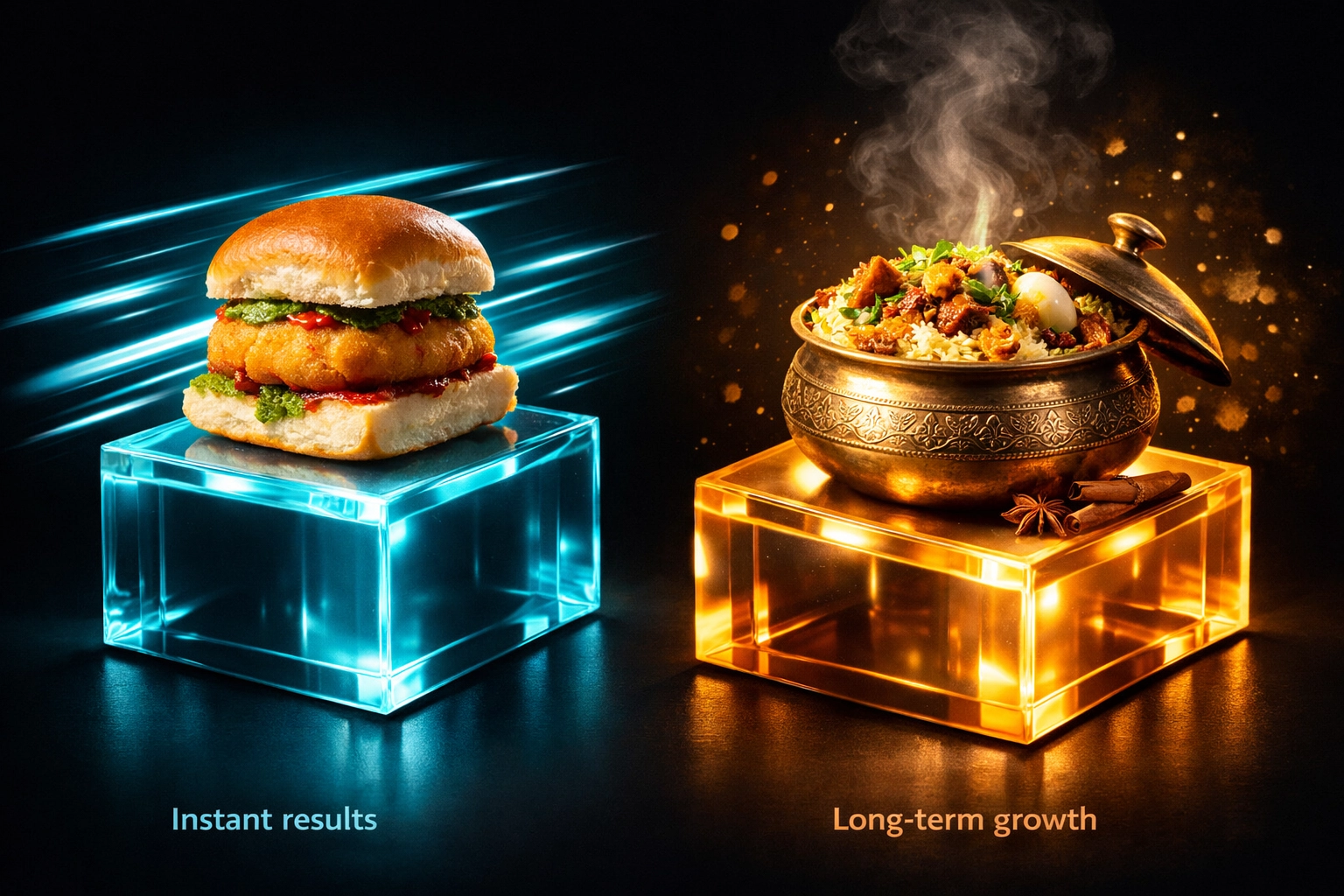
Performance marketing is like ordering a Vada Pav from a street stall. It is instant, it satisfies the hunger immediately, and you know exactly what you are paying for.
- Best for: Immediate lead generation, product launches, and seasonal sales.
- The Reality: The moment you stop paying the vendor, the food stops coming. If your entire strategy relies on “fast food,” your business “health” (margins) will eventually suffer as prices rise.
Organic Growth: The “Home-Cooked Meal” Approach
Organic growth is like a slow-cooked Biryani. It requires prep work, the right ingredients (content), and a lot of patience. You won’t see the results in ten minutes.
- Best for: Brand authority, trust-building, and lowering long-term Customer Acquisition Cost (CAC).
- The Reality: Once it’s ready, it sustains you for much longer at a lower ongoing cost. It builds a “moat” around your business that competitors cannot simply outspend.
The 2026 Reality: Rising CPCs and AI Search (SGE/GEO)
The Mumbai market has seen a massive shift in 2026. If you are still running ads the way you did in 2022, you are likely burning cash.
The CPC Crisis in Mumbai
Cost-Per-Click (CPC) across competitive sectors like real estate, healthcare, and finance in Mumbai has skyrocketed. In 2026, a single click for a “Dermatologist in South Mumbai” keyword can easily cost upwards of ₹250 to ₹400. For an SME with a monthly budget of ₹50,000, your visibility disappears in the blink of an eye.
The Rise of GEO and SGE
Google’s Search Generative Experience (SGE) and Generative Engine Optimization (GEO) have changed the organic game. Users are no longer just clicking links; they are getting AI-synthesized answers.
- Traditional SEO is dead.
- Authority-driven SEO is the new standard. To rank in 2026, your content must satisfy Google’s E-E-A-T (Experience, Expertise, Authoritativeness, and Trustworthiness) standards.
You can learn more about navigating these shifts on our Search Engine Optimization page.
Performance Marketing vs. Organic Growth: A Direct Comparison
| Feature | Performance Marketing (Ads) | Organic Growth (SEO/Content) |
|---|---|---|
| Speed of Results | Instant (24-48 hours) | Slow (4-9 months) |
| Upfront Cost | High (Ad Spend + Fees) | Medium (Content Creation) |
| Long-term ROI | Decreases as competition grows | Increases as authority grows |
| Trust Factor | Lower (Users know it’s an ad) | Higher (Viewed as an authority) |
| Scalability | Linear (Spend more to get more) | Exponential (Compounding returns) |
Why a Hybrid Strategy is Non-Negotiable in 2026
The most successful Mumbai SMEs use Performance Marketing to fund their Organic Growth.
Relying solely on Performance Marketing makes you a slave to the algorithm. Relying solely on Content Marketing might mean you run out of cash before the leads start flowing.
How to Execute the Hybrid Model:
- Phase 1 (Months 1-3): Allocate 80% of your budget to Meta and Google Ads. Use this to generate immediate cash flow and test which “hooks” and “offers” resonate with your Mumbai audience.
- Phase 2 (Months 4-6): Use the data from your ads to inform your SEO strategy. Which keywords converted? Turn those into long-form blog posts or Video Content.
- Phase 3 (Month 6+): As organic traffic begins to convert, slowly shift your ad spend away from broad “awareness” and toward high-intent “retargeting.”

Sector-Specific Advice for Mumbai Businesses
1. Healthcare & Dermatology Practices
In a city obsessed with aesthetics, competition in Bandra and Colaba is fierce.
- Performance: Use Meta Ads for specific treatments (e.g., “HydraFacial Offers in Mumbai”) to fill the diary today.
- Organic: Build a YouTube channel or Instagram presence showcasing “Before & After” results and educational videos. This establishes the doctor as a “Celebrity Expert,” which is vital for high-ticket procedures.
- Pro-Tip: Focus on User-Generated Content where real patients share their journeys.
2. Boutique Hotels & Staycations
With the rise of weekend getaways near Karjat and Alibaug, Mumbai hotels need a visual-first approach.
- Performance: Use Google Travel Ads for direct bookings to avoid heavy OTA commissions (like Booking.com).
- Organic: Invest in high-end Branding and influencer collaborations. A single viral Reel from a lifestyle influencer can generate more organic “saves” than a ₹1,00,000 ad campaign.
The Bismarck World Media Approach: ROI-First
At Bismarck World Media, we don’t believe in “vanity metrics.” We don’t care about “Likes” if they don’t turn into “Lakhs.”
Our strategy for Mumbai SMEs is built on cross-channel alignment. We ensure your paid search data informs your social media strategy, and your Social Media Marketing feeds into your SEO efforts.
Reality Check: If your agency is sending you reports full of “Impressions” but your bank balance isn’t moving, you are being sold a dream, not a strategy. We focus on Qualified Leads and Actual Revenue.

Common Myths vs. Reality
Myth: “SEO is free marketing.”
Reality: SEO costs time and professional expertise. In 2026, “cheap SEO” is worse than no SEO because it can lead to Google penalties that are expensive to fix.
Myth: “Ads are too expensive for SMEs.”
Reality: Ads are only expensive if your conversion rate is low. A well-optimized funnel can turn a ₹1,00,000 spend into ₹5,00,000 in revenue. That’s not an expense; it’s an investment.
Myth: “I can do it all myself.”
Reality: The 2026 algorithm landscape requires specialized knowledge in AI-driven bidding and NLP-based content. Your time is better spent running your business operations.
Final Thoughts: Which Should You Choose?
If you need sales this week, choose Performance Marketing.
If you want to own your market next year, choose Organic Growth.
If you want to scale sustainably, choose both.
Stop chasing “viral” moments and start building a predictable lead-generation machine. Whether you are a clinic in Juhu or a B2B firm in BKC, the digital landscape waits for no one.
Ready to stop wasting your marketing budget?
Explore our Case Studies to see how we’ve scaled brands like yours, or Contact Us for a customized ROI roadmap.

FAQs
Q1: How much should a Mumbai SME spend on digital marketing in 2026?
A: Typically, 5% to 12% of your gross revenue. For a growing SME, we recommend a minimum starting budget of ₹75,000 to ₹1,50,000 per month to see meaningful data and results.
Q2: How long does it take for SEO to show results in 2026?
A: With SGE and GEO, it takes about 4 to 6 months to see significant ranking movements, provided your content is high-authority and technically sound.
Q3: Can I run ads without a website?
A: You can, but it’s a bad idea. Using lead forms on Meta is a short-term fix. A professional website acts as your “digital headquarters” and is essential for building long-term organic trust. Check out our Branding and Marketing Services to get started.
Q4: What is the most important metric to track?
A: MER (Marketing Efficiency Ratio). Total Revenue divided by Total Marketing Spend. If this number is healthy, your hybrid strategy is working.