
Search has fundamentally changed.
Search engines are no longer matching keywords, they are understanding meaning. With the rise of artificial intelligence, Google and other platforms now focus on interpreting context, intent, and real-world relationships behind every query. This shift is known as semantic search, and it is now the foundation of modern SEO and AI-driven search visibility.
In 2026, ranking well is no longer about inserting keywords into content. Instead, success depends on how well your content aligns with semantic search in SEO, how clearly it communicates meaning, and how effectively it satisfies user intent. This evolution is also reshaping how content appears in AI-generated answers, voice search, and Google AI Overviews.
In this guide, we’ll break down how semantic search is redefining SEO, why AI-driven search relies on it, and how you can adapt using a future-ready semantic SEO strategy.
What Is Semantic Search in SEO?
Semantic search refers to a search engine’s ability to understand what a user actually means, not just the exact words they type.
Instead of focusing on keywords alone, Google semantic search evaluates:
- The intent behind a query
- The context of the search
- The relationship between concepts (entities)
- The overall topic relevance
For example, when someone searches:
“Best way to improve website visibility without ads”
Google understands this as a request for SEO strategies, even if the term “SEO” is never used. This level of understanding is powered by AI, natural language processing, and knowledge graphs.
As a result, semantic search in SEO prioritizes meaning over mechanics.
The Shift from Keyword SEO to Semantic SEO
Traditional SEO revolved around:
- Exact-match keywords
- Keyword density
- Separate pages for similar terms
While keywords still play a role, this approach is no longer enough.
Modern semantic SEO strategy focuses on:
- Topics instead of isolated keywords
- Context instead of repetition
- Intent instead of search volume alone
Search engines now analyze whether your content:
- Fully covers a topic
- Answers related questions naturally
- Demonstrates expertise and authority
- Provides a satisfying user experience
This is why one well-structured page can rank for dozens—or even hundreds—of related queries without targeting each one individually.
Why AI-Driven Search Depends on Semantic Understanding
AI-driven search engines are designed to answer questions, not just list links. Features like Google AI Overviews, voice assistants, and conversational AI rely on semantic interpretation to generate accurate responses.
AI-driven search evaluates content based on:
- Topic depth and clarity
- Entity relationships
- Contextual accuracy
- Trust and authority signals
If content lacks semantic depth, it becomes difficult for AI systems to extract reliable answers. This is why semantic SEO is now essential not only for rankings, but also for AI visibility.
In short, if your content isn’t optimized for semantic understanding, it’s unlikely to be surfaced in AI-driven search results.
Search Intent Optimization: The Core of Semantic SEO
At the heart of semantic search lies search intent optimization.
Every search query has a purpose. Google generally classifies intent into four categories:
- Informational
- Navigational
- Commercial
- Transactional
A successful semantic SEO strategy ensures content aligns precisely with the dominant intent behind a query.
For informational searches, content should:
- Educate clearly
- Answer follow-up questions
- Provide structured explanations
When intent is satisfied, search engines see strong engagement signals—leading to better rankings and higher chances of appearing in AI answers.
Understanding Entity-Based SEO
Entity-based SEO is one of the most important pillars of Google semantic search.
An entity is a clearly defined concept such as:
- A brand
- A product or service
- A person
- A location
- A core idea
Google connects these entities through its Knowledge Graph, allowing it to understand how different concepts relate to one another.
By optimizing for entities, you help search engines:
- Identify what your content is truly about
- Associate your brand with specific topics
- Measure topical authority more accurately
Entity-based SEO strengthens both traditional rankings and AI-driven search inclusion.
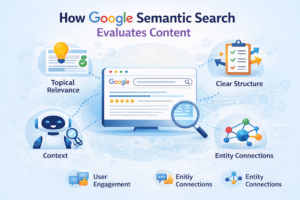
How Google Semantic Search Evaluates Content
Google semantic search uses multiple signals to evaluate content quality, including:
- Topic completeness
- Logical structure and formatting
- Natural language usage
- Entity consistency
- User engagement behavior
- Trust and authority indicators
High-performing semantic content is:
- Easy to read
- Well-organized
- Contextually rich
- Focused on solving user problems
This explains why long-form, informative content consistently outperforms thin, keyword-stuffed pages.
Building a Semantic SEO Strategy for 2026
To succeed in semantic search in SEO, businesses must rethink how content is created and optimized.
1. Focus on Topics, Not Keywords
Create comprehensive content around a core topic and support it with related subtopics.
2. Use Keywords Naturally
Include primary and secondary keywords organically:
- semantic search in SEO
- AI-driven search
- semantic SEO strategy
- Google semantic search
- entity-based SEO
- search intent optimization
Avoid forced placements – context is more important.
3. Structure Content for Humans and AI
Use:
- Clear headings
- Short paragraphs
- Bullet points
- FAQs
This improves readability and helps AI systems extract meaning.
4. Strengthen Entity Signals
Clearly define your brand, services, and expertise areas across your website and online presence.
Semantic Search and the Rise of Voice & Conversational AI
Semantic search also powers:
- Voice search
- Smart assistants
- Conversational AI platforms
These systems rely on natural language understanding and contextual answers. Optimizing for semantic search ensures your content is discoverable across all modern search interfaces—not just traditional SERPs.
Why Semantic Search Is the Future of SEO
Semantic search aligns with Google’s ultimate goal:
Deliver the most helpful answer, as quickly as possible.
As AI-driven search continues to evolve, content that lacks semantic clarity will lose visibility. Businesses that invest in semantic SEO strategy, entity-based SEO, and search intent optimization gain long-term advantages, including:
- Sustainable rankings
- Higher AI visibility
- Better user engagement
- Stronger brand authority
In 2026, SEO success is no longer about gaming algorithms – it’s about being the best answer.
Conclusion
Semantic search has redefined how SEO works. By prioritizing meaning, intent, and entities, AI-driven search delivers smarter, more accurate results. Brands that adapt to Google semantic search by focusing on context, topical authority, and user intent will dominate both search rankings and AI-generated answers.
The future of SEO is semantic – and that future is already here.
FAQs:
1. What is semantic search in SEO?
Semantic search in SEO focuses on understanding the meaning and intent behind user queries rather than matching exact keywords.
2. How does AI-driven search use semantic SEO?
AI-driven search relies on semantic signals to generate accurate answers, making context-rich and entity-optimized content more visible.
3. What is entity-based SEO?
Entity-based SEO optimizes content around clearly defined concepts that search engines recognize and connect through knowledge graphs.
4. Why is search intent optimization important?
Search intent optimization ensures content matches what users actually want, improving rankings, engagement, and AI answer inclusion.
5. How can I optimize my website for Google semantic search?
Focus on topic depth, natural language, structured content, entity clarity, and high-quality information.