
AI vs Human SEO is not an either/or choice. AI is faster at keyword clustering, data analysis, drafting and routine technical checks. Humans are better at strategy, business context, original insight and final quality control. The best results come from using AI for speed and people for decisions.
What Is AI vs Human SEO?
AI vs Human SEO compares using artificial intelligence with using human expertise to plan, execute, analyze and improve search optimization. In practice, the two handle different jobs.
AI is strong at keyword clustering, search intent analysis, content outlines, internal-link suggestions, technical checks, schema drafting and reporting. Humans are responsible for strategy, prioritization, brand positioning, fact-checking, editorial review and conversion decisions.
SEO performance doesn’t come from producing the most content or making the most changes. It comes from making the right changes for the right audience and business goal. That is why many businesses pair AI tools with digital marketing services in Mumbai that keep experts in charge of the decisions.
How Do AI SEO and Human SEO Differ?
AI SEO vs human SEO comes down to scale versus judgment. AI processes large amounts of data quickly. Humans decide what that data means for the business.
|
SEO Activity |
AI Capability | Human Contribution |
|
Keyword research |
Processes large keyword sets quickly |
Determines business relevance |
| Search intent | Identifies patterns and relationships |
Interprets nuanced user needs |
|
Content planning |
Creates outlines and topic clusters |
Sets the strategic direction |
|
Content creation |
Produces drafts quickly |
Adds expertise, experience and judgment |
|
Technical SEO |
Flags patterns and issues |
Decides which problems matter most |
|
Internal linking |
Suggests page relationships |
Chooses meaningful contextual links |
|
Competitor analysis |
Processes large datasets |
Interprets competitive positioning |
|
Reporting |
Summarizes data |
Connects results to business goals |
| Strategy | Offers recommendations |
Makes the final decisions |
What Can AI Do Better in SEO?
AI does better at work that is repetitive, data-heavy and easy to verify. Its main advantage is speed at scale.
Keyword clustering
Take an eCommerce site with thousands of queries. AI can group them by search intent, topic, product category, question type and funnel stage. A human then decides which clusters are worth pursuing.
Content research
AI can turn a broad topic into a structured starting point. For an article on technical SEO, it can surface subtopics such as crawling, indexing, canonicalization, structured data, page speed and internal linking. The SEO professional still validates each point, because speed is not the same as accuracy.
Technical SEO analysis
AI-assisted workflows can flag missing metadata, duplicate titles, broken links, redirect patterns and structured data errors. Finding the issue is only step one. If an audit shows hundreds of similar title tags, a human still decides which pages to change, consolidate, redirect or leave alone.
What Does Human Expertise Bring to SEO?
Human expertise in SEO brings context, experience and accountability. SEO decisions affect real businesses and real customers.
Business context
Two companies can target the same keyword and need different strategies. A clinic that books consultations and an online store selling low-cost products differ in:
- Revenue model and customer lifetime value
- Sales cycle and geographic targeting
- Brand positioning and conversion process
- Customer objections and business priorities
AI can support the analysis, but people decide what matters. This is the role of an SEO agency in practice: connecting search data to business goals.
First-hand experience
Take an article like “How to Choose a Doctor’s Clinic Website Platform” or “How to Set Up a Product Page for Search.” AI can write a generic explanation. A team that has worked with real clients knows the practical details: which questions customers keep asking, where implementations break, and what actually moves results. Google’s guidance encourages content that adds unique value rather than rewording what already exists online.
Can AI Replace SEO Experts?
Can AI replace SEO experts? Not completely. AI can reduce manual work in many tasks, but replacing tasks is different from replacing the function.
AI can answer “What patterns do we see?” A human still has to ask “What should we do about them?” Suppose AI flags a drop in organic traffic. Finding the cause may take Search Console data, analytics, ranking changes, search intent, content quality, technical changes, algorithm updates, competitor moves and indexation checks together. No single dataset gives the answer, and that is where judgment matters.
AI SEO Tools vs SEO Experts: What Is the Difference?
AI SEO tools vs SEO experts is like a calculator versus an accountant. The calculator computes fast. The accountant decides which numbers matter and what to do about them.
Say a tool reports: “Page A has 15 internal links, Page B has 3.” That doesn’t mean Page B needs 12 more. An expert asks whether Page B is commercially important, relevant to other pages, and whether extra links would help users navigate. The tool provides data. The strategist provides judgment.
Is AI-Generated SEO Content Good for SEO?
AI-generated SEO content can work when it is accurate, original and meaningfully reviewed. Publishing AI pages in bulk is not a strategy.
The weak workflow is keyword → AI prompt → article → publish. It produces repetitive, generic pages fast. Google’s spam policies address scaled content abuse: producing large amounts of unoriginal content mainly to manipulate rankings. The policy applies however the content is produced.
The stronger workflow is search data → human strategy → AI assistance → expert review → original insight → optimization → publication → performance analysis. Teams that offer content marketing services use AI inside this kind of system, not as a replacement for it.
How Is AI Changing AEO and GEO?
AI answers are changing what “ranking” means. Search now includes AI-generated answers, and Google publishes guidance on AI features and your website. It says the fundamentals of helpful, reliable, people-first content still apply.
That is where AEO (Answer Engine Optimization) comes in. Instead of only asking “How do I rank for this keyword?”, marketers now ask “Does my content clearly answer the question?” GEO (Generative Engine Optimization) extends the same idea to appearing in AI-generated responses. For a deeper look, see this guide on GEO and AEO.
A strong AEO answer states the direct answer first, then explains it. For example: “AI can automate and accelerate many SEO tasks, but it does not remove the need for human strategy, business context, editorial judgment and quality control.” Clear structure helps both readers and search systems.
What Does a Practical Human + AI SEO Workflow Look Like?
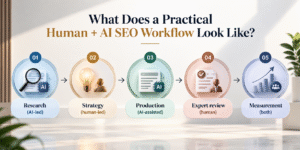
A good AI and SEO workflow has five stages, with AI doing the volume work and humans owning the decisions.
- Research (AI-led): collect and organize keywords, questions, topics, intent patterns and content gaps.
- Strategy (human-led): decide what to target, what to skip, which pages matter and how content fits the site architecture.
- Production (AI-assisted): outlines, first drafts, content briefs, metadata ideas, internal-link suggestions and data summaries.
- Expert review (human): check accuracy, originality, brand consistency, search intent, usefulness and unsupported claims.
- Measurement (both): track clicks, impressions, rankings, engagement, conversions, indexed pages and AI-search visibility where measurable, then feed the results into the next round.
For example, when a company plans a guide, AI can surface related questions. The SEO professional then sets the audience, intent, primary keyword, internal links and conversion goal. AI drafts the structure, an expert adds real customer questions and verified details, and the piece is optimized for headings, metadata and structured data before publishing.
What Should Businesses Automate With AI?
Automate tasks that are repetitive, pattern-based and easy to verify.
Good candidates for AI: keyword clustering, data summaries, content briefs, first drafts, metadata ideas, internal-link discovery, large-scale content audits, spreadsheet analysis and basic technical checks.
Keep humans in charge of: overall strategy, brand positioning, business prioritization, original research, expert claims, sensitive or high-stakes information, conversion strategy and final editorial decisions.
The goal is not to automate everything. It is to automate the right things.
What Is the Future of SEO With AI?
The future of SEO with AI points to more automation and more emphasis on original expertise. As AI absorbs repetitive work, SEO professionals spend more time on strategy, data interpretation, audience research, content differentiation, brand authority and conversion optimization.
The role shifts from producing pages to managing a wider search intelligence workflow. AI is the accelerator. Human expertise is the decision layer.
Conclusion: Use AI for Speed and Humans for Decisions
The useful question isn’t “Who wins, AI or humans?” It is “Which SEO tasks should AI handle, and which decisions need human expertise?” Businesses that use AI without oversight publish faster without necessarily performing better. Businesses that avoid AI waste time on work that could be automated. The advantage is in combining both. If you want a team that does this in practice, explore our SEO services in Mumbai.
- AI handles scale: clustering, analysis, drafts, routine technical checks.
- Humans handle judgment: strategy, business context, originality, quality control.
- AI won’t fully replace SEO experts, but it changes how they work.
- Review and improve AI content; don’t publish it at scale unedited.
- For AEO and GEO, answer questions clearly and add real value.
Frequently Asked Questions
Can AI do SEO better than humans?
AI can perform certain SEO tasks faster and at greater scale, particularly data processing, keyword clustering, content assistance and repetitive analysis. Humans remain important for strategy, context, judgment, originality and business decisions.
Can AI replace SEO experts?
AI can automate parts of an SEO professional’s workflow, but replacing the whole role takes more than automating individual tasks. SEO strategy involves business objectives, audiences, competition, content quality and broader search behavior.
Is AI-generated content good for SEO?
It can be, when it is accurate, relevant, original and meaningfully edited or enhanced. Publishing large amounts of unoriginal content mainly to manipulate rankings can violate Google’s spam policies.
What is the difference between AI SEO and human SEO?
AI SEO uses artificial intelligence to assist with research, analysis, content and automation. Human SEO involves strategic interpretation, decision-making, business context, editorial judgment and expertise.
How can businesses use AI for SEO?
Businesses can use AI for keyword research, content planning, data analysis, technical audits, internal-link discovery, reporting and repetitive optimization, while keeping humans responsible for strategy, verification and final decisions.
Does AEO replace SEO?
No. AEO and traditional SEO overlap but target different search experiences. SEO helps a site get discovered and understood in search, while AEO focuses on giving clear answers to questions. Both belong in a broader search strategy