
Your SEO report just landed. It says 400 new backlinks this month. Feels like a win, right? Not so fast in the backlink quality vs quantity debate, the number on the report and the authority it actually builds are often two very different things. Before you celebrate the count, here’s what you actually need to know.
In the backlink quality vs quantity debate, quality wins backlink quality matters more than backlink quantity in SEO. A large monthly backlink count can look impressive in a report, but if those links come from irrelevant, low-traffic, or spammy websites, they add little to no real authority and can trigger Google’s link-spam penalties. What actually moves rankings and AI search visibility is the number of relevant, credible referring domains, editorial placement, and topical relevance, not the raw link count. For high-trust industries like pharma, healthcare, and finance, this distinction is critical to long-term SEO performance.
400 Backlinks Every Month. It Sounds Impressive.
But here’s a question every business should ask before signing an SEO contract:
Are those backlinks actually building authority, or simply building a bigger number?
In the race to rank higher on Google and become more visible across AI-powered search experiences, businesses are often presented with impressive SEO numbers: hundreds of backlinks, dozens of articles, thousands of keywords, and monthly link-building targets.
But SEO is not a competition to see who can produce the biggest spreadsheet.
More backlinks do not automatically mean better SEO.
In fact, when backlink quantity becomes the objective rather than the outcome, businesses can end up with irrelevant links, low-quality websites, repetitive content, and an unnecessarily spammy backlink profile.
For industries such as pharma, healthcare, medical, finance, and other high-trust sectors, the distinction between more and better becomes even more important.
What Are Backlinks, and Why Do They Matter in SEO?
A backlink is a link from another website to your website. Backlinks help search engines discover pages and understand a website’s authority and relevance but not every backlink carries the same value.
A link from a respected, relevant healthcare publication is fundamentally different from a link placed on an unrelated website created primarily to publish SEO articles. That is why modern SEO link building (bismarckworldmedia.com/search-engine-optimization/) should focus on the quality and context of the links being earned not simply the number.
Backlink Quality vs. Quantity: Which Matters More?
Imagine two websites.
Website A — 400 Backlinks The links predominantly come from:
- Low-quality websites
- Irrelevant industries
- Thin-content blogs
- Generic directories
- Websites with little genuine traffic
- Repetitive guest posts
- Pages created primarily for link placement
Website B — 50 Backlinks The links come from:
- Relevant industry publications
- Established healthcare websites
- Reputable business publications
- Trusted professional resources
- Websites with genuine audiences
- Editorially relevant content
Which website has the stronger backlink strategy? The answer cannot be determined by counting links. Authority is not created simply by adding more URLs to a spreadsheet.
When Link Building Turns Into Link Spam
Google defines link spam as creating links primarily to manipulate search rankings — including buying or selling links for ranking purposes, excessive link exchanges, automated link creation, low-quality directories, and low-value content created primarily to manipulate ranking signals.
That means a link-building campaign should never become:
“We promised 400 links, so we need to find 400 places to put them.”
That approach encourages quantity at the expense of relevance, editorial quality, and user value. Once the objective becomes “get the link” rather than “earn the mention,” the strategy quickly loses its purpose.
Your Website Can Get More Links and Still Get a Worse Backlink Profile
This is one of the biggest misconceptions about backlinks. A website can accumulate hundreds or even thousands of new links while adding very little meaningful authority, because one website can generate multiple links, while the number of genuinely relevant referring domains may remain relatively small.
You may see 1,000 backlinks, but far fewer genuinely valuable websites behind those links. This is why businesses should look beyond the headline backlink number and examine:
- Referring domains
- Domain relevance
- Website credibility
- Organic traffic
- Topical authority
- Editorial placement
- Content quality
- Anchor-text patterns
- Link attributes and longevity
Building genuine topical authority (bismarckworldmedia.com/topical-authority-in-seo-2026/) becoming the recognised source of truth for your subject is what turns a handful of links into real ranking power, because relevant sites naturally want to cite work that demonstrates depth.
The “Spam Problem” Nobody Talks About Enough
A business may initially be happy to see its backlink count rising every month. But over time, an aggressive quantity-first approach can create an ecosystem filled with links that don’t make sense for the brand, a pharmaceutical company suddenly receiving links from unrelated subjects, or dozens of generic articles published every month on sites with little genuine readership.
The report says: “Backlinks increased by 400.”
A deeper audit may reveal: “Most of those links have limited relevance or authority.”
That is not the same thing as building a strong SEO foundation.
SEO and AI Search Are No Longer Separate Conversations
The conversation around backlinks is changing because search itself is changing. People are increasingly encountering information through AI-powered search experiences, including Google AI Overviews and AI Mode, alongside traditional search results.
Google’s own guidance makes an important point: the SEO practices that help pages perform well in traditional search remain relevant to its generative AI search experiences, and Google’s spam policies apply to attempts to manipulate generative AI responses. Read more in our breakdown of Google AI Overviews SEO (bismarckworldmedia.com/blog-google-ai-overviews-seo/) and what it takes to rank in Google’s AI results.
Businesses shouldn’t treat SEO and AI visibility as separate worlds. The bigger opportunity is to build a website that is useful, credible, relevant, well-structured, trusted, and worth referencing.
AI Search Makes Authority Even More Important
When an AI-powered search system generates an answer, the objective isn’t to find the website with the most backlinks, it’s to find sources worth relying on. For brands, this makes AI SEO, AEO, GEO, and traditional SEO increasingly connected.
A company that wants to improve its AI search visibility should stop asking “how many links can we build?” and start asking: “How often is our expertise being referenced, recognised, and associated with our subject area?” That requires strong content marketing (bismarckworldmedia.com/content-marketing/), clear expertise, credible sources, technical SEO, and genuine authority, not just more links.
For Pharma, Quality Matters Even More
Pharma SEO is not the place for a purely volume-driven strategy. Healthcare and pharmaceutical websites operate in an environment where trust, expertise, accuracy, and credibility matter enormously. A pharmaceutical brand should be asking:
- Is the referring website relevant to healthcare or pharma?
- Is the content credible?
- Does the publication have a genuine audience?
- Does the link make editorial sense?
- Does the content demonstrate expertise?
- Is the website itself trustworthy?
- Does the strategy support the brand’s long-term reputation?
A random backlink may increase a metric. A relevant industry mention contributes to brand authority. Those are not the same thing.
So, How Many Backlinks Do You Actually Need?
There is no universal magic number. Not 50. Not 100. Not 400. Not 1,000.
The appropriate link-building volume depends on:
- Your industry and competition
- Your existing authority
- Your website’s age and strength
- Your target keywords
- Your content quality
- Your competitors’ referring domains
- Your digital PR opportunities
- Your overall SEO strategy
The objective should be to close meaningful authority gaps, not to hit an arbitrary monthly quota.
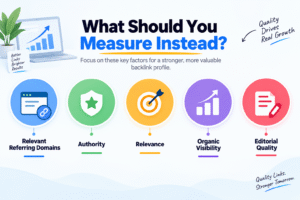
What Should You Measure Instead?
If your SEO agency reports “we built 400 backlinks this month,” ask for more information. Look at:
- Relevant referring domains — How many different, relevant websites actually referenced your brand
- Authority — Credible websites vs. high-volume publishing sites
- Relevance — Whether the linking website has a meaningful connection to your industry
- Organic visibility — Whether the referring website receives genuine search traffic
- Editorial quality — Whether the link was naturally incorporated into useful content
- Keyword performance — Whether your target keywords are actually improving
- c— Whether qualified traffic is increasing
- Conversions — Whether visitors are becoming enquiries, leads, or customers
- Brand visibility — Whether people are increasingly discovering and recognising your business
These are far more meaningful indicators of SEO performance than backlink volume alone. We track exactly these metrics across our client engagements see the results in our case studies (bismarckworldmedia.com/case-studies-bwmedia-1/).
The Best Link-Building Strategy Isn’t About Getting More Links
It’s about becoming more link-worthy:
- Create original research
- Publish genuinely useful industry insights
- Develop expert-led content
- Build resources people want to reference
- Contribute meaningful commentary
- Invest in digital PR
- Create content that answers difficult questions better than competing pages
- Build relationships with relevant publications
- Earn mentions from websites your audience actually trusts
That is organic link building a very different philosophy from simply buying or generating a fixed number of backlinks every month.
Don’t Confuse SEO Activity With SEO Results
A monthly SEO report can be full of activity: 400 backlinks, 50 articles, 100 keywords targeted, 20 directories submitted, 30 outreach campaigns. But activity is not the same as impact. The real questions are:
- Are we becoming more visible?
- Are we attracting the right audience?
- Are our rankings improving for commercially valuable searches?
- Is our website becoming more authoritative?
- Are we becoming a source that people and increasingly AI-powered search experiences can trust and reference?
That is the real purpose of SEO.
The Bottom Line: More Is Not Always More
If someone offers your business 400 backlinks a month, don’t reject the proposal simply because the number is large. Instead, ask for the details:
- Where are the links coming from?
- Are the websites relevant?
- Do they have real audiences?
- How many unique referring domains are involved?
- What is the quality of the content?
- How are the links acquired?
- Are they editorially justified?
- How does the strategy support long-term Google and AI search visibility?
Because the objective isn’t to make your backlink report look impressive. The objective is to make your website worth ranking, worth citing, and worth trusting.
In SEO, 400 weak backlinks are not necessarily better than 40 strong ones. And in the age of AI search, the question is becoming even bigger than backlinks: is your brand building genuine authority across the web, or just building numbers?
Build authority. Build relevance. Build trust. Build something worth referencing. Don’t build backlinks just to increase the backlink count.
Want a straight answer on where your current backlink profile stands? Get a free SEO audit and consultation (bismarckworldmedia.com/contact-us/) no inflated link counts, just a real look at what’s building authority and what isn’t.
- More backlinks ≠ better SEO. Quality, relevance, and editorial context matter more than raw count.
- A high monthly backlink number can hide a spammy, irrelevant link profile Google’s link-spam policies explicitly target manipulative link-building tactics.
- One website can generate many links while still contributing few genuinely valuable referring domains track referring domains, not just backlink totals.
- AI-powered search (Google AI Overviews, AI Mode) rewards the same signals as strong traditional SEO: credibility, relevance, and topical authority not link volume.
- High-trust industries like pharma, healthcare, and finance need especially disciplined, relevance-first link building.
- There’s no universal “right number” of backlinks; the right volume depends on your industry, competition, and existing authority.
- Measure referring domains, relevance, organic traffic, keyword performance, and conversions not the size of the monthly link report.
- The strongest long-term strategy is becoming link-worthy through original research, expert content, and digital PR — not chasing a quota.
Frequently Asked Questions
- Are more backlinks always better for SEO?
No. A large number of low-quality or irrelevant backlinks can add little authority and may even trigger Google’s link-spam policies. Fewer backlinks from relevant, credible, high-traffic websites typically carry far more SEO value than a large volume of weak links. - What is the difference between backlink quality and backlink quantity?
Backlink quantity refers to the total number of links pointing to a website. Backlink quality refers to the relevance, credibility, and authority of the websites providing those links. A website can have thousands of backlinks and still lack real authority if those links come from irrelevant or low-quality sources. - How many backlinks does a website actually need?
There’s no universal number. The right volume depends on the industry, competition level, existing site authority, target keywords, and content quality. The goal should be closing specific authority gaps against relevant competitors, not hitting a fixed monthly quota. - Why is backlink quality especially important for pharma and healthcare websites? Pharma, healthcare, and other high-trust industries are held to a higher standard for accuracy, expertise, and credibility. Irrelevant or low-quality backlinks can undermine a brand’s trustworthiness and reputation in ways that are especially damaging in these regulated, trust-sensitive sectors.
- Do backlinks still matter with Google AI Overviews and AI-powered search?
Yes, but the emphasis has shifted. AI-powered search experiences prioritize credible, relevant, and well-structured sources over raw backlink counts. Businesses building genuine topical authority and earning links from relevant, trusted sites are better positioned to be referenced in both traditional rankings and AI-generated results. - What should businesses ask an SEO agency about their backlink strategy?
Ask about relevant referring domains (not just total links), the credibility and traffic of linking websites, how editorially natural the placements are, and how the strategy connects to actual keyword performance, organic traffic, and conversion not just a monthly backlink count.