
What are the biggest technical SEO mistakes in 2026? The most damaging technical SEO mistakes in 2026 are poor crawlability, indexing errors, weak Core Web Vitals, missing or invalid structured data, broken internal links, and websites that aren’t structured for AI crawlers. Fixing these issues improves both traditional Google rankings and visibility in AI-generated answers like Google AI Overviews, ChatGPT, and Perplexity.
Publishing good content and building backlinks used to be enough. In 2026, it isn’t.
Most ranking losses trace back to technical SEO problems happening behind the scenes — issues that never show up in a content audit because they aren’t content problems at all. Google’s systems now evaluate site speed, structured data, mobile experience, and how “readable” your site is to AI systems, on top of traditional crawl and index signals.
If your site has crawl errors, indexing gaps, duplicate content, or slow load times, no amount of content quality will fully offset it. This guide walks through the technical issues actually costing sites visibility right now, and how to fix each one.
Why Technical SEO Matters More Than Ever
Search engines no longer just read your pages they evaluate your entire site architecture, then decide whether your content is trustworthy enough to summarize in an AI-generated answer.
A technically sound site helps search engines:
- Crawl and discover content efficiently
- Understand relationships between pages
- Index content accurately
- Surface content in AI Overviews and other generative results
- Deliver a fast, stable experience on any device
This is also where Answer Engine Optimization (AEO) comes in: technical foundations like structured data and clean site architecture are now prerequisites for showing up in AI-powered answers, not just blue links.
1. Ignoring Crawl Errors
If crawlers can’t reach your pages, nothing else matters content, backlinks, and keyword targeting are irrelevant to a page Google never sees.
Common crawl errors:
- Broken URLs and redirect loops
- Server errors (5xx)
- Blocked resources
- Misconfigured robots.txt rules
Fix it: Run a crawl audit via Google Search Console and a crawler tool (Screaming Frog or Sitebulb). Fix broken URLs, remove unnecessary redirect chains, and resolve server errors. On large sites, this also protects your crawl budget so important pages get crawled more often than low-value ones.
2. Poor Google Indexing
A page that isn’t indexed doesn’t exist to Google, no matter how well it’s written.
Common causes:
- Accidental noindex tags
- Duplicate URLs without canonicalization
- Thin or low-value content
- Weak internal linking to the page
Fix it: Check the Pages report in Search Console for exclusion reasons. Clean up duplicate URLs, strengthen internal links to orphaned pages, and keep your XML sitemap current — submit it again after any major content push.
3. Weak Core Web Vitals
Google’s three Core Web Vitals metrics still directly affect both rankings and user behavior:
Largest Contentful Paint (LCP): should load in under 2.5 seconds. Usually slowed by unoptimized images, heavy JavaScript, or slow hosting.
Cumulative Layout Shift (CLS): should stay under 0.1. Caused by missing image dimensions, late-loading ads, or web fonts shifting text.
Interaction to Next Paint (INP): should stay under 200ms. Driven by heavy JavaScript execution and third-party scripts blocking the main thread.
Fix it: Compress and convert images to WebP, lazy-load below-the-fold content, minify code, defer non-critical scripts, and use a CDN. Site speed is one of the few ranking factors you can improve almost entirely through technical work no content changes required.
4. Poor Mobile SEO
Google evaluates your site primarily through mobile-first indexing, meaning the mobile version of your page, not the desktop version, is what determines your rankings.
Common mistakes: tiny fonts, buttons placed too close together, intrusive pop-ups, and layouts that force horizontal scrolling.
Fix it: Test every key page in Google’s mobile usability tool, use responsive design (not a separate mobile subdomain), and remove pop-ups that cover content before a user has scrolled.
5. Incorrect Canonical Tags
Canonical tags tell search engines which version of a page to index. Get this wrong, and you create duplicate content problems that dilute ranking signals across multiple URLs instead of consolidating them into one.
Common mistakes: self-conflicting canonicals, canonical chains, and canonicalizing unrelated pages.
Fix it: Every important page needs exactly one canonical URL, pointing to the HTTPS version, matching what’s in your sitemap and internal links.
6. Poor XML Sitemap Optimization
An outdated sitemap slows down content discovery; new pages take longer to get crawled, and old, removed pages keep wasting crawl budget.
Fix it: Your sitemap should only include indexable, canonical, live URLs. Strip out redirected, noindexed, or broken pages, and resubmit it after major site changes.
7. Robots.txt Mistakes
One misplaced line in robots.txt can block your entire site from Google without any warning.
Common errors: blocking CSS/JS files (which prevents Google from rendering pages correctly), disallowing important directories, and leaving in outdated rules after a migration.
Fix it: Review robots.txt after every major site change. It should allow crawling of essential content, block only genuinely low-value sections, and reference your current sitemap.
8. Missing or Incorrect Structured Data
Structured data is one of the highest-leverage technical fixes for AI search visibility. It gives search engines and AI crawlers explicit, machine-readable context about your content, which directly affects whether you get pulled into rich results, featured snippets, and AI Overviews.
Common mistakes: missing schema entirely, invalid markup, using the wrong schema type, or letting JSON-LD go stale after a content update.
Fix it: Implement Organization, LocalBusiness, Article, FAQPage, Breadcrumb, Product, Review, and Service schema wherever relevant, and validate everything after deployment. This is also foundational to Answer Engine Optimization, allowing search engines to generate accurate answers in Google AI Overviews and other generative search experiences a topic we cover in more depth in our guide to Google AI Overviews SEO.
9. Broken Internal Links and Weak Internal Linking
Internal links do three jobs at once: help search engines discover new pages, signal topical relevance, and pass authority between pages. A weak internal linking structure undermines all three.
Common problems: 404s, orphan pages with zero internal links pointing to them, and generic anchor text like “click here” instead of descriptive, keyword-relevant text.
Fix it: Link blog content to relevant service pages, connect pillar content to supporting cluster articles, and always use descriptive anchor text tied to the destination page’s topic — never brand or product names as anchors.
10. Ignoring HTTPS Security
HTTPS has been a confirmed ranking signal for years, but migrations still leave sites with mixed-content warnings and inconsistent URL versions.
Fix it: Every page should load securely, HTTP should permanently redirect to HTTPS, and internal links, canonicals, and your sitemap should all reference HTTPS URLs only.
11. Poor URL Structure
Long, parameter-heavy URLs are harder for both users and crawlers to parse.
Bad: example.com/page?id=45874&category=seo Good: example.com/technical-seo-checklist
Fix it: Keep URLs short, descriptive, and consistent; avoid unnecessary numbers, symbols, and dynamic parameters wherever possible.
12. Not Optimizing for AI Search
Ranking on page one is no longer the finish line. Search behavior is shifting toward conversational queries and AI-generated answers, and sites need to be structured for both traditional crawlers and AI systems.
Key factors for AI search visibility:
- Comprehensive topic coverage (not thin, single-angle pages)
- Strong entity optimization and clear content hierarchy
- Structured data across key page types
- EEAT signals (experience, expertise, authoritativeness, trust)
- Fast, stable, mobile-friendly pages
This broader shift is what’s driving the move toward Search Everywhere Optimization, treating AI chatbots, AI Overviews, and traditional search as one connected visibility strategy rather than separate channels. If you’re still evaluating how much this changes your existing playbook, our breakdown of Google AI Mode vs. traditional SEO is a useful next read.
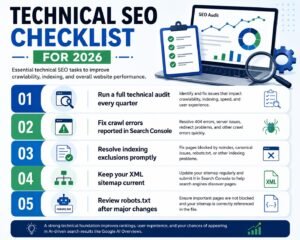
Technical SEO Checklist for 2026
- Run a full technical audit every quarter
- Fix crawl errors reported in Search Console
- Resolve indexing exclusions promptly
- Keep your XML sitemap current
- Review robots.txt after major changes
- Improve LCP, CLS, and INP
- Confirm every page passes mobile usability tests
- Implement and validate schema markup
- Fix broken links and redirect chains
- Strengthen internal linking with descriptive anchors
- Verify canonical tags across key pages
- Enforce HTTPS sitewide
- Use clean, descriptive URL structures
- Structure content for AI search visibility
Conclusion
Technical SEO is the foundation everything else sits on. Strong content and a solid backlink profile can only carry a site so far if search engines struggle to crawl, index, or trust it.
Fixing crawl errors, indexing gaps, weak Core Web Vitals, broken links, and missing schema builds the foundation for durable organic growth one that holds up in both traditional search results and AI-generated answers.
TL;DR: Technical SEO in 2026 covers far more than crawlability. Core Web Vitals, structured data, mobile usability, and AI-readiness are now baseline requirements for ranking in Google Search and in AI Overviews alike. Regular audits, clean site architecture, and validated schema markup are non-negotiable.
Why Choose Bismarck World Media for Technical SEO?
We help businesses fix the technical issues holding their sites back from crawlability and Core Web Vitals to schema implementation and AI search readiness as part of a broader SEO strategy built around measurable ranking and traffic growth. Our content marketing team pairs every technical fix with content built to actually convert once it’s found.
Get a free technical SEO audit to see exactly what’s holding your site back.
Frequently Asked Questions
- What is technical SEO?
Technical SEO is the practice of optimizing a website’s infrastructure, speed, indexing, structured data, Core Web Vitals, mobile experience, and crawlability so search engines can access and understand content effectively. - Why is technical SEO important in 2026?
It determines whether your content is even eligible to rank or appear in AI-generated answers. Strong technical foundations improve both traditional search visibility and inclusion in Google AI Overviews and other generative results. - How often should I run a technical SEO audit?
At least once every three to six months, and immediately after any major redesign, migration, or platform change. - What are the most common technical SEO issues?
Crawl errors, indexing problems, slow page speed, weak Core Web Vitals, broken links, duplicate content, missing schema markup, and outdated sitemaps. - How do Core Web Vitals affect SEO?
They measure loading speed, visual stability, and responsiveness, all of which influence both rankings and how long users stay engaged with a page. - Does schema markup improve rankings?
Not directly, but it helps search engines understand your content accurately, which increases eligibility for rich results, featured snippets, and AI Overviews. - Can technical SEO improve AI search visibility?
Yes. Structured data, clear content organization, fast load times, and strong internal linking all improve how well AI systems can parse and surface your content.