
Search is moving beyond traditional lists of blue links toward AI-generated answers, conversational discovery, comparisons and multi-step research, making visibility across search experiences more important than rankings alone. Google reported that AI Overviews had reached more than 1.5 billion users across 200+ countries and territories by May 2025, highlighting the rapid adoption of AI-powered search. At the same time, zero-click behaviour is becoming increasingly significant, with a Similarweb dataset analysed by SparkToro showing that 68.01% of Google searches in the US ended without a click between January and April 2026. AI-driven referrals are also growing, with Semrush reporting a 66% increase in AI traffic during 2025, although it still accounted for less than 0.15% of total visits in its dataset. These developments suggest that the winning strategy for SEO trends 2027 will not be about simply publishing more AI-generated content. Instead, businesses will need to build technically accessible, genuinely useful, trustworthy and recognisable digital assets that provide real value to users and can be accurately understood, referenced and surfaced by AI-powered search systems.
How Will AI Change Search in 2027?
SEO trends 2027 point toward a major shift from a keyword-and-ranking model to an answer-and-discovery model.
Instead of searching “best SEO services for a small business” and opening ten pages, users can increasingly ask a conversational system to compare options, explain trade-offs, recommend products and provide sources in one interaction.
Google’s AI Overviews and AI Mode already demonstrate this direction. Google says AI Mode is designed for longer, more complex questions and can use a technique called query fan-out, where multiple related searches are performed across different subtopics and sources before producing a response.
ChatGPT has also moved search into a conversational environment. OpenAI’s search experience provides timely answers with links to web sources, while its search systems can conduct multiple searches for complex questions.
The key implication for SEO trends 2027 is that ranking for one keyword will become less useful as a standalone objective. Brands will need to become reliable sources across an entire topic, demonstrate genuine expertise, maintain strong technical foundations and provide information that search systems can confidently understand, connect and reference.
This means SEO strategies will increasingly focus on topical authority, brand visibility, structured information, first-hand expertise and visibility across multiple search experiences rather than simply chasing individual keyword positions.
1. AI Overviews and AI Search Will Become a Bigger Part of the Search Journey
Google’s AI search evolution is already substantial.
In May 2025, Google reported that AI Overviews had reached more than 1.5 billion users and were available in more than 200 countries and territories and over 40 languages. Google also reported more than 10% growth in usage for the types of searches where AI Overviews appeared in major markets including the US and India.
India is particularly relevant for businesses targeting the Indian market. Google began rolling out AI Mode in India in July 2025 and subsequently expanded the experience to Hindi.
What should businesses do?
Do not create separate “AI Overview content.”
Google explicitly states that existing SEO fundamentals remain relevant for AI features and that there are no additional technical requirements or special schema types specifically required to appear in AI Overviews or AI Mode.
Instead:
- Make important information available in text.
- Answer questions directly.
- Build strong internal links.
- Keep pages indexable.
- Demonstrate first-hand experience.
- Support claims with credible evidence.
- Make your brand and entities easy to understand.
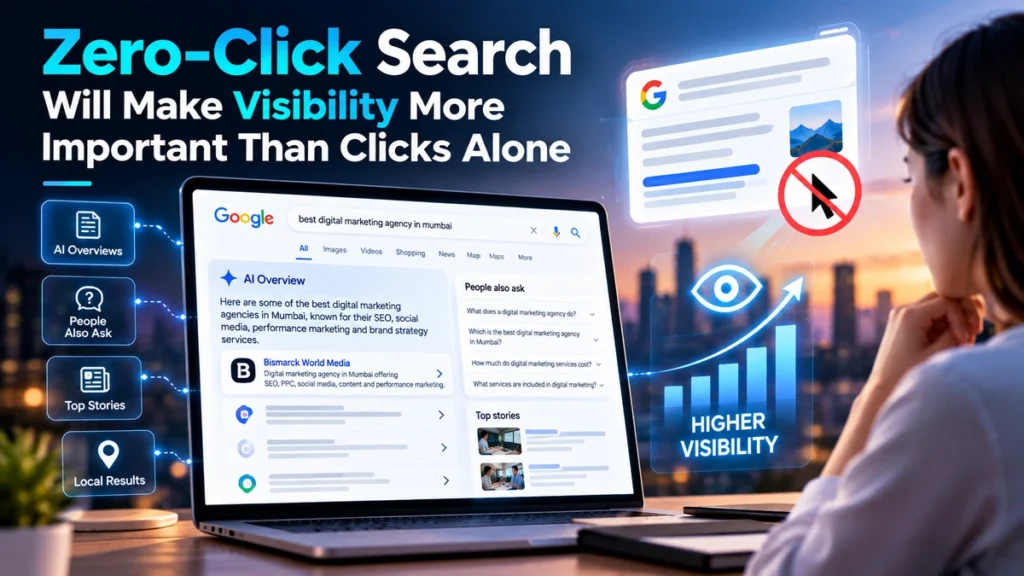
2. Zero-Click Search Will Make Visibility More Important Than Clicks Alone
Traditional SEO reporting often revolves around impressions, rankings and clicks. AI-powered search makes that model incomplete.
A June 2026 analysis from SparkToro, using Similarweb clickstream data, found that 68.01% of Google searches in the US ended without a click during January-April 2026. The analysis attributed the continued growth of clickless behaviour to AI features, search-interface elements and changing user behaviour.
This does not mean websites are becoming irrelevant.
It means a brand can benefit from search visibility even when the user does not immediately visit its website.
For example, a potential customer might see a company mentioned in an AI-generated comparison, remember the brand and later search for it directly.
The new KPI mix
Businesses should increasingly monitor:
- Brand mentions in AI answers
- Search visibility
- Non-branded impressions
- Branded searches
- AI referrals
- Assisted conversions
- Organic conversions
- Qualified leads
- Revenue from organic discovery
The goal is moving from “How many clicks did we get?” to “How often does our brand influence the customer journey?”
3. ChatGPT and Other AI Platforms Will Become Additional Discovery Channels
Google is not the only search environment businesses need to consider.
OpenAI introduced ChatGPT search to provide timely answers with links to relevant web sources.
Current OpenAI guidance also explains that websites can become eligible for ChatGPT search by allowing OAI-SearchBot to crawl their content. OpenAI separately provides controls for GPTBot, meaning website owners can manage search discovery and model-training crawling independently.
Industry data already shows the direction.
Ahrefs analysed 3,000 websites in 2025 and found that 63% received some AI traffic, while ChatGPT accounted for approximately half of AI referral traffic in that study.
Semrush’s larger 2026 study found AI traffic grew 66% in 2025, while ChatGPT outbound referral traffic increased 206% year over year from January 2025 to January 2026.
What this means for SEO
Your website should not be optimised exclusively for Google.
Check whether:
- Important pages are crawlable.
- OAI-SearchBot is unintentionally blocked.
- Your brand information is consistent across the web.
- Your company is mentioned by credible third parties.
- Your content clearly establishes what your business does.
- Product, service and location information is accurate.
This is an emerging area of search optimization rather than a replacement for traditional SEO.
4. E-E-A-T and First-Hand Experience Will Matter More
AI can generate a 1,500-word article in seconds. That makes generic information easier to produce, and therefore less valuable as a competitive advantage.
Google’s guidance says its systems aim to prioritise helpful content and use signals associated with experience, expertise, authoritativeness and trustworthiness (E-E-A-T). Google also specifically notes that trust is the most important aspect.
This creates an opportunity for businesses with genuine expertise.
Instead of publishing:
“Here are 10 benefits of digital marketing.”
A stronger article could include:
- Original campaign observations
- First-hand examples
- Before-and-after results
- Expert commentary
- Industry-specific data
- Screenshots or original research where appropriate
- Clear authorship
- Sources for important claims
AI can help with research and structure, but it should not replace human expertise.
Google also warns that generating large numbers of pages with AI without adding value can fall under its scaled-content-abuse policy.
5. Technical SEO Will Become the Foundation of AI Visibility
AI cannot reliably understand what it cannot access.
Google’s technical requirements remain straightforward: Googlebot must not be blocked, the page must work successfully, and the page needs indexable content.
For AI search, that foundation becomes even more important because AI systems need discoverable sources from which to construct answers.
Priorities for 2027
Audit:
- Robots.txt
- XML sitemaps
- Canonical tags
- Internal linking
- Indexability
- JavaScript rendering
- Mobile experience
- Core Web Vitals
- Page speed
- Structured data
- Redirects
- Duplicate content
Google also recommends making important content easily discoverable through internal links and ensuring important information is available in textual form.
Technical SEO is therefore not becoming less important because of AI.
It is becoming the infrastructure that allows AI systems to discover your content.
6. Search Intent Will Become More Conversational and Complex
The old model:
Keyword → Page → Click
is increasingly becoming:
Question → Context → Multiple searches → AI synthesis → Sources → Decision
Google reported that early AI Mode testers were asking queries two to three times longer than traditional searches.
This means content strategies should cover the complete decision journey.
For example, instead of creating one page targeting “water purifier,” a brand could build a useful topic ecosystem covering:
- Which water purifier is suitable for hard water?
- RO vs UV vs UF
- How much water does a family need?
- Water purifier maintenance costs
- How frequently should filters be replaced?
- Which purifier is suitable for an apartment?
- What should buyers check before purchasing?
The opportunity is not simply targeting longer keywords.
It is understanding the questions behind the questions.
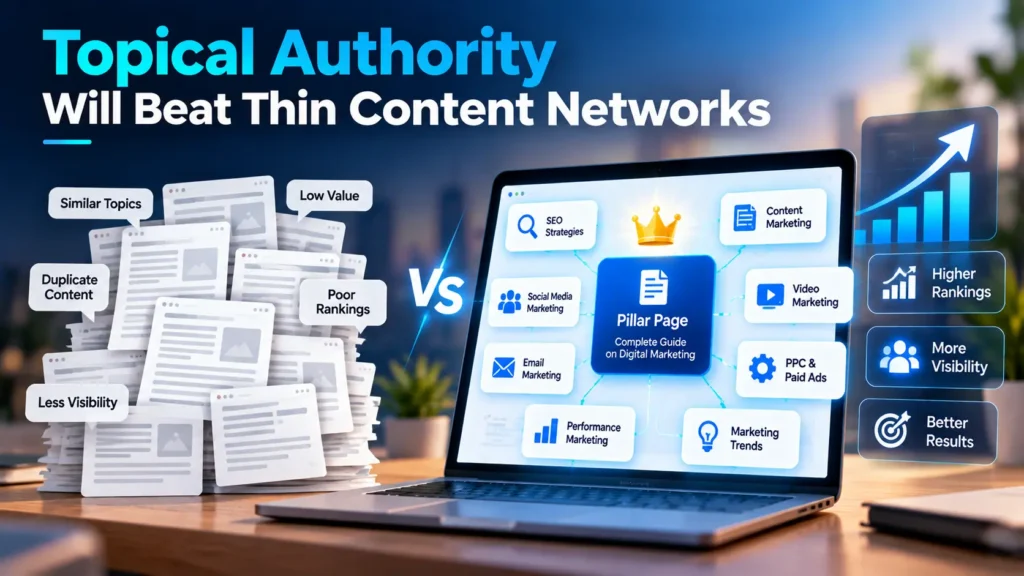
7. Topical Authority Will Beat Thin Content Networks
One of the biggest risks of AI-assisted publishing is producing dozens of pages that say almost the same thing.
A stronger strategy is to build a structured topic ecosystem.
For example, a healthcare brand could create:
Pillar: Preventive Healthcare
Supporting clusters:
- Health checkups
- Diagnostic tests
- Blood pressure
- Diabetes screening
- Women’s health
- Men’s health
- Preventive testing by age
Each page should add something different rather than repeatedly rewriting the same information.
Google’s people-first guidance emphasises satisfying the user’s purpose and producing genuinely useful main content rather than content created primarily to manipulate rankings.
8. Brand Entity Strength Will Become an Emerging Competitive Advantage
A website is only one part of a brand’s digital identity.
AI systems increasingly have to determine:
- Who is this company?
- What does it offer?
- Where does it operate?
- What does it specialise in?
- Which products or services belong to it?
- What independent sources mention it?
- Can its claims be trusted?
That makes consistent brand information increasingly important.
Businesses should maintain consistency across:
- Website
- Google Business Profile
- Business directories
- Industry publications
- Social profiles
- Reviews
- Author profiles
- Partner websites
- Press coverage
- Product databases
This is particularly important for local businesses, healthcare organisations, professional services and B2B companies.
Practical Action Plan for 2027
Businesses preparing for AI-driven search can start with this six-step framework:
1. Audit technical accessibility
Check crawling, indexing, canonicalisation, sitemaps, internal links and page experience.
2. Rebuild content around user problems
Map content to informational, commercial, transactional and navigational intent.
3. Add genuine expertise
Include original insights, authorship, experience, data, examples and trustworthy references.
4. Strengthen your brand entity
Make your business information consistent across important websites and platforms.
5. Optimise for answer extraction
Use descriptive headings, concise definitions, tables, FAQs, clear explanations and supporting evidence.
6. Measure beyond rankings
Track organic clicks alongside impressions, branded demand, conversions, qualified leads and AI referral traffic.
Importantly, don’t chase every new “AI SEO hack.” Google states that its existing SEO fundamentals remain applicable to AI features, and there is no special markup that guarantees inclusion in AI Overviews or AI Mode.
Conclusion
The biggest change ahead is not that search engines are becoming “AI-powered.” It is that the way people discover, evaluate and trust information is changing.
By 2027, successful search strategies are likely to combine technical SEO, helpful content, brand authority, first-hand expertise, structured information and visibility across multiple discovery platforms.
The evidence already shows the transition: Google has expanded AI search globally, ChatGPT provides web-based search with citations, AI referral traffic is growing rapidly, and a substantial share of Google searches now end without a traditional website click.
The smart response is not to abandon SEO.
It is to build a better version of it.
Bismarck World Media helps businesses combine technical SEO, content strategy, AEO, GEO and AI-search optimisation to build sustainable search visibility and measurable business growth. If your business wants to prepare its website for the next generation of search, explore the agency’s SEO services in Mumbai or contact Bismarck World Media for a tailored strategy.
Key Takeaways
- Build for answers, not just rankings: Content should directly solve the user’s problem and cover the complete search journey.
- Strengthen trust: Original insights, first-hand experience, credible sources and clear authorship will become increasingly valuable.
- Protect the technical foundation: Crawling, indexing, internal linking, structured information and page experience remain essential.
- Measure visibility differently: Track brand visibility, AI referrals, conversions and qualified leads, not rankings and clicks alone.
- Prepare for multiple search environments: Google, ChatGPT and other AI-powered discovery platforms should increasingly be considered part of the broader search ecosystem.
FAQs
1. Will traditional SEO still matter in 2027?
Yes. AI search still depends heavily on discoverable, indexable and useful web content. Google explicitly states that existing SEO fundamentals remain relevant for AI Overviews and AI Mode.
2. Do I need a special schema for AI Overviews?
No. Google says there is no special schema or additional structured-data requirement specifically for AI Overviews or AI Mode. Standard SEO and structured-data best practices still matter.
3. Will AI completely replace Google Search?
There is no evidence supporting that prediction. Google’s traditional search remains extremely significant, while AI experiences are being integrated into Search itself. A better strategy is to prepare for multiple discovery environments rather than betting on one platform.
4. Can AI-generated content rank on Google?
AI-assisted content can appear in search when it provides value and complies with Google’s policies. However, Google warns against producing large volumes of low-value pages through automation or generative AI.
5. How can a business prepare for AI search?
Start with technical SEO, then improve content quality, first-hand expertise, topical coverage, brand authority and structured information. Also monitor visibility and referrals from AI platforms alongside traditional organic performance.