
Social media marketing strategies help businesses reach relevant audiences, build brand awareness, strengthen customer relationships and generate qualified leads. But posting regularly without a clear plan rarely delivers consistent business results. An effective strategy connects audience research, content creation, platform selection, engagement and performance measurement to specific marketing objectives.
For businesses looking to grow their online presence, the focus should be on creating content that answers customer questions, communicates the brand’s value and encourages meaningful action. Whether a company wants to attract new customers, improve engagement or generate enquiries, a well-planned strategy can support its wider digital marketing efforts.
In this guide, we explore 12 practical strategies businesses can use to improve social media performance, along with a campaign planning framework and key metrics for measuring success.
The most effective social media marketing strategies are to define your audience, choose the right platforms, publish genuinely useful content, plan with a content calendar, use short-form video, optimise for social search, engage in real conversations, partner with relevant creators, run targeted paid campaigns, use AI responsibly, study competitors and measure results against business goals.
What Is a Social Media Marketing Strategy?
A social media marketing strategy is a documented plan that explains how a business will use social media platforms to achieve its marketing goals. It defines the target audience, content approach, publishing schedule, engagement methods, advertising activities and performance indicators.
A strong strategy typically includes five essential elements:
- Audience research: Understanding the needs, interests, challenges and preferences of potential customers.
- Platform selection: Identifying the social networks that best match the target audience and business objectives.
- Content planning: Deciding which topics, formats and messages will provide value to the audience.
- Community engagement: Building relationships through conversations, comments, messages and customer feedback.
- Performance measurement: Evaluating results and improving campaigns based on relevant data.
For example, a B2B software company might use LinkedIn to share industry insights, product demonstrations and customer success stories. A fashion retailer might prioritise Instagram to showcase products, share styling advice and encourage customers to participate in brand conversations.
The right approach depends on the company’s audience, industry, available resources and marketing goals. A strategy should provide direction without preventing the team from adapting to changing customer needs.
Why Is Social Media Marketing Important for Businesses?
Social media marketing allows businesses to communicate directly with their audiences, demonstrate their expertise and stay connected with customers throughout the buying journey.
Its value extends beyond gaining followers or receiving likes. When social media activity supports clear business objectives, it can contribute to brand visibility, website traffic, customer engagement and lead generation.
Here are five important benefits of social media marketing for businesses.
- Increases brand awareness
Consistent, relevant content helps audiences recognise a business, understand what it offers and become familiar with its products or services. - Builds customer relationships
Responding to questions, acknowledging feedback and participating in relevant conversations makes it easier for customers to interact with a brand. - Supports lead generation
Educational content, targeted advertising, landing pages and enquiry forms can help move interested users towards a business conversation or purchase. - Drives relevant website traffic
Social media posts can direct users to service pages, product listings, blog articles and other resources that help them make informed decisions. - Provides useful audience insights
Comments, messages, content performance and customer feedback can reveal common questions, buying concerns and topics that deserve further attention.
These benefits are most meaningful when social media activity is measured against business outcomes rather than vanity metrics alone.
12 Social Media Marketing Strategies That Drive Results
1. Define Your Target Audience Before Creating Content
Every effective social media marketing strategy starts with a clear understanding of the people the business wants to reach.
Without audience research, even well-designed content can attract the wrong users or fail to address the problems potential customers want to solve.
Start by identifying your audience’s needs, interests, purchasing behaviour, preferred content formats and common challenges. For B2B businesses, useful details may include job roles, industries, company sizes and decision-making responsibilities. For consumer brands, location, interests, lifestyle and purchasing preferences may be more relevant.
Use customer interviews, sales conversations, website analytics, social media insights and competitor research to understand your audience.
Example: An accounting software company serving small businesses might discover that its audience frequently struggles with invoice tracking, expense management and financial reporting. It can use these insights to create practical content that addresses those challenges.
Actionable tip: Develop one or two audience profiles that describe your ideal customers, their main concerns and the information they need before making a purchase.
2. Choose the Right Social Media Platforms
Businesses do not need to maintain an active presence on every social media platform. The better approach is to prioritise channels where their target audience is active and where the business can consistently publish useful content.
Different platforms support different content formats and marketing objectives.
- Instagram: Useful for visual storytelling, product discovery, Reels and lifestyle-focused content.
- Facebook: Can support community engagement, local business communication and advertising campaigns.
- LinkedIn: Particularly relevant for B2B marketing, professional networking, industry expertise and reaching business decision-makers.
- YouTube: Suitable for tutorials, product demonstrations, educational videos and detailed explanations.
- Pinterest: Can support visual discovery for businesses in areas such as home decor, fashion, food and design.
These are general starting points rather than strict rules. The most appropriate platform depends on audience behaviour, the product or service and the campaign objective.
For example, a company selling enterprise software may prioritise LinkedIn for professional content and use YouTube for product tutorials. A home decor brand may focus on visual content and product inspiration. Online stores should also look at how social commerce is transforming eCommerce, since many platforms now support shopping directly in the feed.
Actionable tip: Start with the platforms most relevant to your audience. Review their performance periodically before expanding to additional channels.
3. Create Valuable and Relevant Social Media Content
One of the most effective social media marketing tips is to give people a useful reason to engage with your content.
Audiences regularly encounter promotional posts, product announcements and sales messages. If every post focuses on selling, a business may struggle to establish meaningful relationships with its followers.
Instead, create content that answers customer questions, explains relevant topics, demonstrates expertise or helps people solve a problem. This is the same principle behind effective content marketing: useful content earns attention and trust before it asks for a sale.
A balanced content strategy can include:
- Educational content: Tips, explanations, industry insights and how-to guides.
- Problem-solving content: Practical advice addressing common customer challenges.
- Product or service content: Demonstrations, features, use cases and relevant benefits.
- Trust-building content: Verified testimonials, customer stories and genuine case studies.
- Behind-the-scenes content: Team introductions, work processes and company culture.
- Promotional content: Offers, product launches and clear calls to action.
For example, a digital marketing agency could publish a post explaining common technical SEO mistakes, a video demonstrating how to interpret a Search Console report and a case study using verified client results.
This approach gives the audience useful information while helping the company communicate its expertise.
Actionable tip: Before publishing, ask yourself whether the post answers a question, solves a problem, builds trust or supports a specific business objective.
4. Build a Consistent Social Media Content Calendar
A social media content calendar helps marketing teams organise publishing schedules, coordinate campaigns and maintain consistency.
Without a documented plan, content creation can become reactive. Posts may be rushed, campaign deadlines can be missed and the same topics may be repeated without a clear purpose.
A useful content calendar should include:
- Publishing date and platform
- Topic and content format
- Target audience and objective
- Caption and creative requirements
- Call to action
- Assigned team member
- Performance notes after publication
Here is an example of a simple weekly social media content calendar.
| Day | Content format |
Primary objective |
|
Monday |
Educational post |
Build brand awareness |
| Tuesday |
Short-form video |
Reach relevant audiences |
|
Wednesday |
FAQ or question-led post |
Encourage engagement |
| Thursday | Industry insight or case study |
Build credibility |
| Friday | Product or service post |
Generate enquiries |
This is a sample schedule, not a universal posting frequency. The right number of posts depends on the platform, audience behaviour, content quality and available resources.
A content calendar should also allow room for timely industry updates, customer questions and relevant conversations.
Actionable tip: Plan content in advance, but review the calendar regularly so the team can adjust topics and formats based on performance.
5. Use Short-Form Video to Explain Ideas and Demonstrate Value
Short-form videos can help businesses communicate ideas quickly, demonstrate products, answer common questions and introduce the people behind a brand.
However, creating videos simply because the format is popular is not enough. Each video should have a clear purpose and a message that matters to the target audience. Investing in professional video production can raise quality, but even simple, well-planned videos work when the message is useful.
Businesses can experiment with:
- Quick tutorials and practical demonstrations
- Answers to frequently asked customer questions
- Product features and use cases
- Expert explanations of industry topics
- Behind-the-scenes videos
- Customer experiences, where permission has been obtained
Start with a clear opening that tells viewers what they will learn. Keep the main explanation focused, use readable captions when helpful and finish with a relevant next step.
Example: A cybersecurity company could create a short video explaining how to recognise common phishing warning signs. The content provides practical value while demonstrating the company’s knowledge.
Measure video performance using metrics such as watch time, completion rate, shares, saves, profile visits and relevant website clicks. Views alone do not establish whether a video is helping the business achieve its objectives.
Actionable tip: Test a small number of video formats, identify which topics generate meaningful audience responses and build on those insights.
6. Optimise Social Media Content for Search and Discovery
Social media platforms are increasingly used to discover businesses, products, services and answers to specific questions. Social search should therefore be part of a broader social media content strategy.
The goal is to make it easy for users to understand what a post, profile or video offers.
Businesses can improve discoverability by:
- Using relevant keywords naturally in captions and headings
- Writing clear profile descriptions that explain their products or services
- Adding descriptive video titles where supported
- Using relevant hashtags when they help categorise content
- Including accurate location information for local businesses
- Answering questions that potential customers are likely to ask
- Linking to relevant website resources when additional information is useful
For example, an interior design business in Mumbai could create content about small-apartment interior design or modular kitchen planning if these topics match its services and customer interests.
Avoid unrelated keywords, excessive hashtags and repetitive captions. Content should read naturally and accurately describe what users will find.
Social search and website SEO can complement one another. A social post may introduce a topic, while a relevant website article provides a more detailed explanation. As AI-powered results grow, it also helps to understand Google AI Mode vs traditional SEO so your content is easy to discover and cite.
Actionable tip: Research the language your audience uses, then incorporate relevant terms naturally into your social profiles and content.
7. Encourage Meaningful Audience Engagement
Effective social media engagement strategies focus on building relationships rather than generating interactions for their own sake.
Responding to comments, answering messages, acknowledging customer feedback and participating in relevant discussions can help a business understand its audience and maintain trust.
Businesses can encourage meaningful engagement by:
- Asking relevant questions that invite genuine responses
- Responding to comments with useful information
- Using polls or question stickers where appropriate
- Encouraging customers to share experiences
- Turning recurring questions into educational content
- Joining conversations relevant to the business’s expertise
For example, a skincare brand could ask customers which part of their skincare routine they find confusing. The responses could help the marketing team identify useful topics for future educational posts.
Avoid engagement bait that encourages meaningless comments solely to increase interaction. The objective is to create conversations that benefit the audience and provide useful feedback to the business.
Actionable tip: Monitor recurring questions and comments. Use them to improve future content, product explanations and customer communication.
8. Collaborate With Relevant Creators and Industry Experts
Creator partnerships can help businesses introduce their products or services to audiences that may not yet know the brand.
However, choosing a creator based only on follower count can lead to poor campaign alignment. Audience relevance, credibility, content quality, engagement patterns and brand fit are important considerations.
Potential collaboration formats include:
- Product demonstrations
- Educational videos
- Expert interviews
- Sponsored posts
- Event coverage
- Customer stories and product experiences
For example, a fitness equipment company could collaborate with a relevant fitness creator to demonstrate how a product fits into a home workout routine. Authentic user-generated content from real customers and creators can build trust faster than polished brand messaging.
Before agreeing to a partnership, define the campaign objective, deliverables, timeline, budget, content usage rights and measurement criteria. Sponsored content should be disclosed in accordance with applicable rules and platform requirements.
Measure campaign performance using relevant reach, referral traffic, enquiries, conversions and acquisition costs where applicable.
Actionable tip: Prioritise creators whose audiences match your target customers and whose content style fits your brand’s values.
9. Use Social Media Advertising to Generate Relevant Leads
Organic social media helps businesses develop an audience over time. Paid advertising can complement those efforts by reaching selected audiences and supporting specific campaign objectives.
Social media advertising can help businesses promote products, drive website traffic, collect enquiries and reconnect with eligible audiences who have previously interacted with their brand. It works best as part of a wider performance marketing approach, alongside intent-driven channels such as paid search campaigns.
Before launching an advertising campaign, decide what success should look like. A brand awareness campaign requires different creative and measurement from a campaign designed to generate qualified leads.
A practical campaign process includes:
- Set the objective: Decide whether the campaign is intended to increase awareness, drive traffic, generate leads or support sales.
- Define the audience: Use relevant targeting criteria based on the platform and campaign goal.
- Create focused advertising content: Communicate a clear benefit and give the audience a reason to act.
- Match the landing page to the advertisement: Ensure the destination delivers what the ad promises. If visitors arrive but do not enquire, see why your website gets traffic but no leads.
- Test creative variations: Compare relevant messaging, formats and calls to action.
- Review campaign performance: Evaluate lead quality and business outcomes, not just impressions or clicks.
Example: A payroll software company could run a campaign inviting business owners to book a product demonstration. The landing page should explain the product’s value and make it easy to request a demo.
Track cost per qualified lead, conversion rate and eventual customer acquisition cost where the data is available. Leads that are not ready to buy can be nurtured through email marketing.
Actionable tip: Start with a clearly defined objective and a measurement plan. Adjust campaign budgets based on reliable performance data rather than assumptions.
10. Use AI Tools to Support Social Media Content Planning
AI tools can help marketing teams brainstorm topics, organise content calendars, generate initial caption ideas, summarise research and adapt existing material for different platforms.
Their value lies in supporting the creative process and reducing repetitive tasks, not replacing human judgement. If you are comparing options, our breakdown of ChatGPT vs Claude vs Gemini for marketing results can help you choose.
A practical workflow could look like this:
- Identify a customer question or content opportunity.
- Use an AI tool to generate initial ideas or an outline.
- Verify facts and check the information against reliable sources.
- Edit the content to reflect the brand’s voice and audience needs.
- Adapt the format for the intended platform.
- Review audience response and improve future content.
For example, a detailed educational blog post could be repurposed into a LinkedIn post, a short-video outline and several social media tips. Each version should be adapted to its platform instead of being copied without changes.
AI-generated content should be checked for accuracy, originality, tone and relevance. Avoid publishing unverified statistics, invented customer experiences or generic messaging that could apply to any company.
Actionable tip: Use AI to speed up research and drafting, while keeping fact-checking, strategic decisions and final editing with the marketing team.
11. Analyse Competitors and Relevant Industry Developments
Competitor analysis helps businesses understand how other brands position themselves, which topics they cover and where they may be overlooking audience needs.
Review competitors’ content themes, formats, publishing patterns, audience responses, offers and messaging. Pay attention to the questions customers ask and the types of posts that encourage meaningful discussions.
The goal is not to reproduce another company’s content. It is to identify opportunities to offer something more relevant, specific or useful.
For example, if competitors primarily publish product announcements, a business could differentiate itself by creating tutorials, practical comparisons, detailed use cases or expert explanations.
Industry developments can also inspire content, but not every trend is relevant to every brand. Choose topics that align with the audience, company expertise and business objectives.
A monthly competitor review can help the team identify content gaps, emerging customer concerns and changes in market positioning.
Actionable tip: Keep a simple competitor analysis sheet with content themes, observed strengths, audience questions and opportunities for original content.
12. Track Social Media Performance and Optimise Your Strategy
Measuring performance helps businesses see whether their social media activities are supporting their marketing goals.
The right metrics depend on the objective of each campaign.
| Marketing objective |
Metrics to monitor |
|
Brand awareness |
Reach, impressions, audience growth |
| Audience engagement |
Comments, shares, saves, engagement rate |
|
Website traffic |
Link clicks, website sessions, landing page visits |
|
Lead generation |
Qualified leads, conversion rate, cost per lead |
| Sales |
Conversions, revenue, customer acquisition cost |
| Video performance |
Watch time, completion rate, relevant actions |
Use native platform analytics to understand content performance and website analytics to evaluate what visitors do after clicking through. Where appropriate, use UTM parameters to identify traffic from specific campaigns.
Review performance over a meaningful period rather than making decisions based on one unusually successful or unsuccessful post.
For example, if educational videos generate relevant website visits while promotional graphics receive limited interaction, the team could test additional educational videos and refine their calls to action. You can see how this kind of analysis plays out in real campaigns in our client case studies.
Reporting should lead to clear decisions about which topics to continue, which formats to improve, which audiences to refine and how to allocate resources.
Actionable tip: Schedule regular performance reviews and document the insight, proposed change and result of each meaningful experiment.
A Practical Social Media Campaign Planning Framework
The 12 strategies above become easier to implement when they are connected through a clear campaign workflow.
Use the following framework to plan a campaign before creating content or allocating advertising budget.
| Step | What to define |
Example |
|
Business objective |
The outcome the business wants |
Generate relevant product enquiries |
|
Target audience |
Who the campaign should reach |
Small business owners |
| Audience problem | The need or challenge to address |
Difficulty managing payroll |
|
Content approach |
The information or creative to publish |
A product demonstration video |
|
Distribution channel |
Where the content will appear |
LinkedIn and selected paid channels |
|
Call to action |
The next step for the audience |
Book a product demonstration |
| Measurement | How success will be evaluated |
Qualified enquiries and conversion rate |
| Optimisation | What to test or improve |
Messaging, creative or landing page |
This is an illustrative framework, not a guaranteed campaign result. Businesses should adapt each step to their industry, audience, budget and sales process.
The main principle is to connect each piece of content to a clear purpose and a measurable next step.
How to Measure the Success of a Social Media Marketing Strategy
A social media marketing strategy should be evaluated according to the business objectives it is designed to support.
Start by establishing a baseline using existing platform and website data. Set realistic targets for a defined period, identify the relevant metrics and decide how results will be reported.
For example, a business focused on brand awareness may prioritise relevant reach and audience growth. A company focused on lead generation may concentrate on qualified enquiries, landing page conversion rates and cost per qualified lead.
It is also important to distinguish activity from outcomes. Publishing 20 posts in a month measures content output; it does not demonstrate whether those posts generated business value.
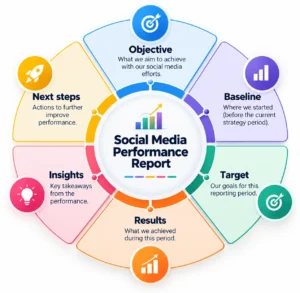
A useful social media performance report should include:
- Objective: What was the campaign intended to achieve?
- Baseline: What was the starting level of performance?
- Target: What result would represent meaningful progress?
- Results: What happened during the reporting period?
- Insights: Which content, audiences or campaigns performed best?
- Next steps: What should the team continue, change or test?
Where relevant, connect social media metrics to website behaviour and business outcomes. For example, use tagged campaign links to understand which social channels contribute to relevant visits and enquiries.
This approach helps marketing teams explain not only what happened but also what should happen next.
Common Social Media Marketing Mistakes to Avoid
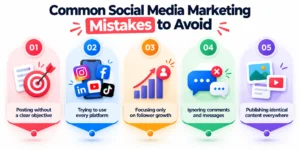
Even experienced marketing teams can lose time and resources when their social media activities lack direction. Avoid these common mistakes:
Posting without a clear objective: Every post does not need to generate a lead, but the overall content plan should support defined business or audience goals.
Trying to use every platform: Maintaining too many channels can spread resources thin and reduce content quality.
Focusing only on follower growth: A larger audience does not automatically mean better engagement, qualified leads or sales.
Ignoring comments and messages: Delayed or unhelpful responses can undermine trust and miss opportunities to understand customer needs.
Publishing identical content everywhere: Different platforms have different formats and audience expectations. Adapt content accordingly.
Ignoring performance data: Without regular reviews, teams may continue investing in content that produces limited results.
Publishing unverified AI-generated material: Inaccurate claims, invented examples and generic messaging can damage credibility.
Expecting immediate results: Building brand awareness, developing relationships and generating consistent leads often require ongoing testing and refinement.
Avoiding these mistakes makes it easier to maintain a focused, measurable and sustainable social media presence.
Frequently Asked Questions About Social Media Marketing
What are the most effective social media marketing strategies?
The most effective social media marketing strategies include defining the target audience, choosing relevant platforms, publishing useful content, encouraging meaningful engagement, using paid campaigns when appropriate and measuring performance. The right combination depends on the business’s objectives, industry and audience.
How can businesses increase social media engagement?
Businesses can increase social media engagement by publishing relevant content, answering customer questions, using suitable video formats, responding to comments and encouraging genuine conversations. Reviewing shares, saves, comments and other relevant metrics helps identify what resonates with the audience.
Which social media platform is best for business marketing?
There is no single best social media platform for every business. LinkedIn is particularly relevant for many B2B companies, Instagram can support visual discovery, Facebook can help with community engagement and advertising, and YouTube is useful for educational video content. Platform selection should be based on audience behaviour and business goals.
How often should a business post on social media?
Posting frequency depends on the platform, audience expectations, available resources and content quality. A consistent, sustainable schedule is generally more useful than publishing frequently without a clear purpose. Businesses should test their schedule and adjust it using performance data.
How can social media marketing generate leads?
Social media marketing can generate leads through educational content, targeted advertisements, product demonstrations, relevant offers, website links and enquiry forms. Businesses should use clear calls to action, direct interested users to relevant landing pages and measure the quality and conversion rate of the leads generated.
How do you measure social media marketing success?
Social media marketing success can be measured using metrics such as reach, engagement rate, website traffic, qualified leads, conversion rate and revenue. The appropriate metrics depend on the campaign objective. Businesses should connect platform analytics with website data and business outcomes wherever possible.
What is the difference between organic and paid social media marketing?
Organic social media marketing involves publishing content and engaging with audiences without paying for distribution. Paid social media marketing uses advertising budgets to distribute content to selected audiences. Businesses often combine both approaches: organic content builds relationships and communicates expertise, while paid campaigns can support targeted reach and specific conversion goals.
How can AI help with social media marketing?
AI can support topic research, content ideation, caption drafting, content repurposing and performance analysis. Marketing teams should verify facts, review the final content and ensure that every post reflects the brand’s expertise and audience needs.
Conclusion
Effective social media marketing requires more than maintaining an active presence across different platforms. Businesses need to understand their audiences, publish relevant content, encourage genuine interactions and measure the results against clear objectives.
The most useful social media marketing strategies combine thoughtful content planning, platform selection, social search optimisation, creator partnerships, paid advertising and ongoing performance analysis. Not every tactic will deliver the same results for every business, which is why testing and refinement are essential.
Start by defining the outcomes you want to achieve, focus on the platforms that matter most to your audience and build a content plan that connects customer needs with business goals. Review the results regularly and use those insights to improve the next campaign.
With a clear strategy and a consistent measurement process, social media can become a more valuable part of a business’s wider digital marketing and lead generation efforts.
Need Help Building Your Social Media Strategy?
If you are looking for a social media marketing agency in Mumbai that connects content, creators and paid campaigns to measurable results, Bismarck World Media can help. Book a free consultation to review your current presence and identify practical opportunities for growth.