
The 4 Ps of marketing are Product, Price, Place and Promotion. They are the four decisions a business controls when it takes an offering to market: what it sells, what it charges, where customers can buy it, and how it communicates its value. Together they form the marketing mix.
A good product alone does not create demand. Customers also need to find it, understand why it is worth the price, and be able to buy it easily. The 4 Ps give you a simple checklist to plan all of that in one place instead of making disconnected decisions.
In this guide, we explain what each P means, show how well-known brands apply them, walk through a step-by-step process for using the marketing mix, and cover how SEO, social media, paid ads and AI are changing the framework.
What Are the 4 Ps of Marketing?
The four elements answer four practical questions:
| Marketing element | The question it answers | Business focus |
| Product | What are we offering? | Meeting a real customer need |
| Price | What will customers pay? | Perceived value and profitability |
| Place | Where and how can customers buy it? | Availability and convenience |
| Promotion | How will people hear about it? | Awareness, engagement and conversions |
The four elements are connected. A premium product needs a price that signals quality, a distribution channel that suits premium buyers, and messaging that explains why it costs more. If one P points in a different direction, customers notice.
Where the Marketing Mix Comes From
The term “marketing mix” was popularised by Harvard professor Neil Borden in the 1950s. Marketing scholar E. Jerome McCarthy then simplified the many variables into four groups, Product, Price, Place and Promotion, in his 1960 book Basic Marketing: A Managerial Approach. That simple structure is the version most businesses still use today.
Why the 4 Ps Still Matter
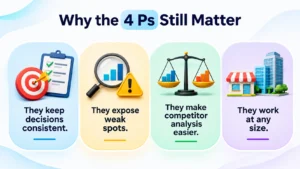
- They keep decisions consistent. Your pricing, packaging, channels and messaging all reinforce the same positioning.
- They expose weak spots. If sales are low, the 4 Ps help you check whether the problem is the offer, the price, the reach or the message.
- They make competitor analysis easier. You can compare your mix against rivals element by element.
- They work at any size. A neighbourhood clinic and a global brand can both use the same framework.
1. Product: Build Something Customers Actually Need
Product covers the goods or services you offer, and everything around them: quality, design, features, packaging, brand name, customer support and warranties. For a service business, it also includes how the service is delivered.
Before launching or improving a product, ask:
- Which customer problem does it solve?
- How is it different from alternatives customers already have?
- What quality level does the target audience expect?
- Is the value strong enough to justify the price?
Example: Apple. Apple’s product strategy goes beyond hardware specifications. Design, software, services and the connected ecosystem make the iPhone, Mac and Apple Watch feel like one experience, which helps the brand support premium positioning.
How to apply it: Run customer surveys, read reviews, study competitor offerings and talk to your sales team. Then improve the product based on what customers actually say, not on assumptions. For a D2C or retail business, this includes product pages, photos and descriptions, which is where content marketing starts to overlap with product strategy.
2. Price: Set a Price That Reflects Value
Price is what customers pay, but it also tells them something about your brand. A low price can signal affordability or lower quality; a high price can signal exclusivity or premium value.
Good pricing looks at production costs, competitor prices, customer willingness to pay, demand and your profit targets together. Common pricing strategies include:
- Penetration pricing: a low entry price to win market share quickly.
- Premium pricing: a higher price that signals quality or exclusivity.
- Competitive pricing: prices set with reference to rivals.
- Value-based pricing: prices based on the value customers believe they receive.
- Psychological pricing: price points such as ₹999 instead of ₹1,000 that change how the price feels.
Example: Netflix. Netflix offers subscription plans at different price points and feature levels, so customers can choose what fits their budget and viewing habits. Tiered plans let one product serve several customer segments.
How to apply it: Start with your costs and target margin, then test price points against what customers value. Track average order value and profit margin, not only sales volume. Discounting without a plan can win short-term sales but weaken your brand over time.
3. Place: Make It Easy to Buy
Place is about where and how customers can access your product. Even an excellent product loses sales if customers cannot find it or the buying process is inconvenient.
Common channels include physical stores, your own website, marketplaces, distributors and wholesalers, franchise outlets, mobile apps and direct-to-consumer sales. The right mix depends on your product, your audience’s buying habits and your geography.
Example: Amazon. Amazon’s marketplace, fulfilment network and delivery infrastructure make buying fast and convenient across thousands of product categories. For Amazon, place is a core part of the customer experience.
How to apply it: Find out where your customers already shop and meet them there. A local clothing brand, for example, might combine a physical store, its own website and social commerce. If your buyers search online first, being easy to find is part of “place” too, which is where SEO supports distribution. Our article on how social commerce is transforming eCommerce covers one fast-growing channel in detail.
4. Promotion: Communicate Your Value and Drive Action
Promotion covers every way you tell people about your product, build trust and encourage them to act. Common methods include:
- Search engine optimisation (SEO)
- Pay-per-click advertising (PPC) and other paid media
- Social media marketing
- Email marketing
- Content marketing
- Influencer marketing and user-generated content
- Public relations
- Sales promotions and offers
Example: Coca-Cola. Coca-Cola combines advertising, sponsorships, packaging and brand storytelling to keep its brand recognisable and emotionally familiar across markets.
How to apply it: Choose channels based on where your audience spends time. A B2B software company may prioritise SEO, LinkedIn and webinars, while a fashion brand may lean on Instagram, video and creators. Our guides to social media marketing, email marketing and performance marketing show how these channels work in practice.
Whatever the channel, your message should state one clear value proposition and point customers to a next step.
How to Apply the 4 Ps to Your Business: A 5-Step Process
Knowing the framework is the easy part. Here is how to use it.
Step 1: Define your target audience
Identify who is most likely to buy: age, location, income, interests, problems they want solved and how they research purchases. Simple customer personas help you keep that picture clear.
Step 2: Research needs and buying behaviour
Use surveys, reviews, website analytics, search data and competitor research to learn what customers expect from your product, how much they will pay, where they prefer to buy and which channels influence them.
Step 3: Draft your marketing mix
Write one clear decision for each P: the product and its main benefit, the price and positioning, the main sales channels, and the promotional channels and message. Check that all four support the same positioning.
Step 4: Choose channels and set a budget
Pick channels based on audience behaviour, campaign goals, resources and expected return. Start with the two or three channels most likely to reach buyers, rather than spreading the budget thinly.
Step 5: Measure and refine
Track results for each element and adjust regularly:
| Marketing element | Useful metrics |
| Product | Customer satisfaction, product returns, repeat purchases |
| Price | Profit margin, revenue, average order value |
| Place | Distribution reach, availability, sales by channel |
| Promotion | Website traffic, engagement, leads, conversion rate, ROAS (return on ad spend) |
If your website gets visitors but few enquiries, the issue may sit in a different P than you expect. Our guide on why a website gets traffic but no leads explains how to diagnose it.
Example: Applying the 4 Ps to a Local Business in Mumbai
Imagine a coaching institute in Mumbai that wants more admissions. Here is how the marketing mix could look:
| Element | Decision |
| Product | Small-batch classes, mock tests and a progress report for parents |
| Price | Clear fee tiers, an early-enrolment discount and instalment options |
| Place | A physical centre, an online batch option and a Google Business Profile so nearby parents can find it |
| Promotion | Local SEO, Google Ads for admission-season searches, Instagram content and parent testimonials |
The four elements support each other: the product answers parents’ concerns, the price is easy to compare, the place is easy to reach and the promotion goes where parents are searching. For a deeper look at this sector, read our guide to digital marketing for schools and coaching institutes in Mumbai or explore our education marketing services.
4 Ps in Action: How Leading Brands Use the Mix
The four brands above each lean on a different P, but all four coordinate the full mix:
| Brand | Strongest P | How it shows up |
| Apple | Product | Design and ecosystem support premium pricing, selected retail channels and feature-led campaigns |
| Netflix | Price | Tiered subscriptions let different customer segments choose their level |
| Amazon | Place | Marketplace, fulfilment and delivery make buying convenient |
| Coca-Cola | Promotion | Consistent advertising and wide availability keep the brand familiar |
| McDonald’s | Place and Product | A recognisable menu with market-specific options, available through restaurants, drive-throughs, apps and delivery |
The lesson is that no brand wins on one P alone. They align all four around one customer experience.
4 Ps vs 7 Ps of Marketing
The 4 Ps were designed with physical products in mind. Service businesses such as agencies, clinics, schools and consultancies usually add three more elements, creating the 7 Ps:
| Element | Meaning |
| Product | What you offer |
| Price | What customers pay |
| Place | How customers access it |
| Promotion | How you communicate it |
| People | The employees and specialists who deliver the service |
| Process | The systems and steps used to deliver it |
| Physical evidence | Tangible proof such as your website, reports, reviews and case studies |
Example: a digital marketing agency. The product is SEO, paid media and social services. Price is retainers or project fees. Place is the website and online consultations. Promotion is SEO, social media and referrals. People are strategists, writers, designers and account managers. Process is onboarding, strategy, execution and reporting. Physical evidence is case studies, reports and client reviews.
You may also see the 4 Cs (Customer, Cost, Convenience, Communication), a customer-centred version of the same framework. Product, Price, Place and Promotion map neatly onto it, so it is a useful way to check that you are looking at each decision from the buyer’s point of view.
How Digital Marketing Is Changing the 4 Ps
The framework has not changed, but digital channels have changed how each P works.
SEO and content marketing
Search is now one of the main ways customers discover and compare products. Helpful pages, guides and product content help you appear when customers search, which supports both Promotion and Place. Start with technical SEO fundamentals, because crawl and speed problems can hold back otherwise good content.
Paid media and social platforms
Paid campaigns let you reach audiences by interest, location and behaviour, and measure results quickly. Those learnings can also inform Product and Price: the offers and messages that convert tell you what customers value. Our search engine marketing and social media marketing services are built around this feedback loop.
AI search and answer engines
Customers increasingly get answers from Google AI Overviews, AI Mode and chat-based tools before they click any link. To stay visible, your pages need clear, answer-focused content, structured information and strong topical authority, which is often called AEO (answer engine optimisation) or GEO (generative engine optimisation). Read more in our guides to Google AI Overviews SEO and Google AI Mode vs traditional SEO.
Using AI in your marketing mix
AI can help analyse customer behaviour, personalise emails, recommend products and speed up reporting. It works best as support for marketing judgement, not a replacement for it. We compare the two approaches in AI vs human SEO.
Common Marketing Mix Mistakes to Avoid
- Guessing what customers want. Building a product from assumptions leads to poor product-market fit. Research first.
- Competing only on price. Constant discounts squeeze margins and can weaken your brand. Communicate value instead.
- Choosing the wrong channels. If your buyers do not shop or search where you sell, reach suffers.
- Sending inconsistent messages. Your website, ads, social posts and sales team should all tell the same story. A clear branding strategy helps keep it consistent.
- Not measuring results. Without data, you cannot tell which P needs attention.
- Treating the 4 Ps as separate boxes. The elements work only when they support each other.
Frequently Asked Questions About the 4 Ps of Marketing
What are the 4 Ps of marketing?
The 4 Ps of marketing are Product, Price, Place and Promotion. They make up the traditional marketing mix that businesses use to plan what they sell, what they charge, where they sell it and how they promote it.
Why are the 4 Ps of marketing important?
They help businesses align their offering, pricing, distribution and communication with customer expectations. This creates a consistent strategy and supports brand positioning, customer acquisition and growth.
What is an example of the 4 Ps of marketing?
Apple is a common example. It focuses on product design and user experience, uses pricing that supports premium positioning, sells through its own stores, online and partners, and promotes both product features and brand value.
What is the marketing mix?
The marketing mix is the set of controllable decisions a business uses to position its product in the market. In the traditional model, these are Product, Price, Place and Promotion.
What is the difference between the 4 Ps and 7 Ps of marketing?
The 7 Ps add People, Process and Physical Evidence to the original four. The extended model suits service businesses, where customers judge the people, processes and proof behind the service.
How can small businesses use the 4 Ps?
Small businesses can start by understanding customer needs, then choose a focused product, a profitable price, one or two sales channels and low-cost promotion such as local SEO, social media and email.
How do the 4 Ps apply to digital marketing?
Digital marketing mainly supports Promotion and Place, through SEO, paid ads, social media, email and online sales channels. The data these channels produce also helps refine Product and Price decisions.
How do the 4 Ps influence consumer behaviour?
They shape how customers perceive a product, judge its price, access it and respond to messages. Together these affect purchase decisions, brand preference and loyalty.
Conclusion
Product, Price, Place and Promotion remain a practical foundation for any marketing plan. The framework works best when the four elements are planned together, backed by customer research and reviewed against real performance data.
If you want help turning the marketing mix into a measurable growth plan, the team at Bismarck World Media can support you across SEO, performance marketing, content and social media. See what we have delivered in our case studies, or book a free consultation to discuss your goals.
Related reading: Why your website gets traffic but no leads · Google AI Overviews SEO · Technical SEO mistakes in 2026