
Mumbai’s healthcare landscape is more competitive than ever. Whether you run a multi-speciality hospital in Bandra or a diagnostic centre in Thane, the rules of patient acquisition have fundamentally changed. In 2026, digital marketing for hospitals in Mumbai is no longer optional — it is the primary engine driving patient enquiries, OPD appointments, and brand trust.
Patients today don’t just walk into the nearest hospital. They Google symptoms, compare reviews, watch doctor videos on YouTube, and WhatsApp a hospital’s number before making a decision. This guide breaks down exactly which digital channels and strategies are producing real, measurable patient enquiries for hospitals across Mumbai right now.
| 78%
of patients in Mumbai search online before choosing a hospital |
3x more enquiries from hospitals with active Google Business Profiles |
| 62%
of healthcare searches now happen on mobile devices |
40% of new patient bookings influenced by online reviews |
1. Google Search: The Single Biggest Driver of Patient Enquiries
When someone in Andheri wakes up with chest pain or a parent in Mulund needs an oncologist, their first action is almost always a Google search. This is why SEO for hospitals in Mumbai remains the most powerful long-term investment a hospital can make.
Strong hospital SEO in 2026 is built on three pillars: a well-optimised Google Business Profile (GBP), location-specific landing pages such as ‘cardiologist in Bandra,’ and content that answers patients’ actual questions. Hospitals like Kokilaben Dhirubhai Ambani Hospital and Lilavati Hospital rank prominently because they consistently publish expert health content that matches real search queries.
What to optimise right now:
- Claim and fully complete your Google Business Profile with updated photos, timings, and services
- Create individual specialty pages targeting local intent keywords — e.g., ‘Knee Replacement Surgery in Mumbai’
- Build a patient FAQ section on your website with questions like ‘best hospital for cancer treatment in Mumbai’
- Earn backlinks from Mumbai health directories and reputable news portals
- Optimise for Google’s SGE (Search Generative Experience) by structuring content with clear headings and direct answers
2. Google Ads for Hospitals: High-Intent Traffic That Converts Fast
Organic SEO takes time. If your hospital needs patient enquiries this month, Google Ads for hospitals in Mumbai is where you start. Paid search puts your hospital at the top of results for high-intent searches like ’emergency hospital near me’ or ‘IVF specialist Mumbai.’
The key is targeting the right keywords and sending traffic to dedicated, conversion-optimised landing pages — not your homepage. Hospitals that run Google Ads without a proper landing page strategy waste a significant portion of their budget. A well-structured campaign with geo-targeting to specific Mumbai zones such as Bandra, Powai, and Navi Mumbai consistently delivers a lower cost-per-enquiry than broad campaigns.
Pro Tip: Use call extensions in your Google Ads. In Mumbai’s healthcare market, over 55% of hospital ad interactions come from direct phone calls — not form submissions. Make it easy for patients to call with one tap.
3. Social Media Marketing for Healthcare: Building Trust Before the Appointment
Social media marketing for healthcare in 2026 is less about going viral and more about building the kind of trust that makes a patient choose your hospital over the one down the street. Instagram, Facebook, and YouTube are where Mumbaikars discover and evaluate hospitals before they ever make an enquiry.
Content formats that consistently perform for Mumbai hospitals include doctor explainer videos, patient success stories shared with full consent, behind-the-scenes content from speciality departments, and health awareness posts tied to seasonal trends — dengue season, monsoon health tips, and festive-season cardiac care advisories.
Hiranandani Hospital’s social media presence is a strong local example of healthcare content done right: consistent, educational, and community-focused. The goal is not to sell but to be genuinely useful, which builds the brand equity that drives enquiries organically.
4. Online Reputation Management: Reviews Are the New Word-of-Mouth
Online reputation management for hospitals is perhaps the most underrated lever in patient enquiry generation. In a city like Mumbai, where healthcare choices are abundant, patients trust Google Reviews, Practo ratings, and Justdial comments as much as they trust personal referrals.
A hospital with 4.6 stars and 400 reviews will consistently outperform a hospital with 3.9 stars and 60 reviews — even if the latter provides superior clinical care. The gap is almost entirely a marketing problem, not a quality problem.
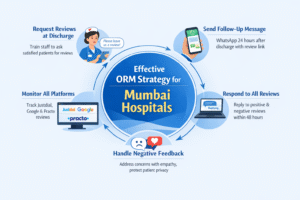
An actionable ORM system for Mumbai hospitals:
- Train discharge staff to ask satisfied patients to leave a Google or Practo review
- Send a WhatsApp message 24 hours after discharge with a direct review link
- Respond to every review — positive and negative — within 48 hours
- Monitor Justdial, Google, and Practo simultaneously using a reputation dashboard
- Address negative reviews empathetically without disclosing any patient data
5. WhatsApp Marketing: Mumbai’s Most Direct Patient Communication Channel
WhatsApp marketing for hospitals in India has evolved from a convenience to a clinical communication essential. With over 500 million active WhatsApp users in India a large proportion based in Mumbai — it is now the fastest way to convert an enquiry into a booked appointment.
In 2026, forward-thinking hospitals are using WhatsApp Business API to automate appointment confirmations, send pre-procedure instructions, share test reports securely, and run health awareness broadcast campaigns. Unlike SMS, WhatsApp messages are consistently read — open rates exceed 90% in the healthcare segment.
A structured WhatsApp workflow can reduce no-show rates by up to 30% and significantly improve patient satisfaction scores. More importantly, it creates a communication experience that patients naturally share with friends and family — one of the most powerful forms of organic hospital marketing.
6. Hospital Website Lead Generation: Converting Visitors into Enquiries
Hospital website lead generation is where all your other digital efforts ultimately land. Your website is your 24/7 front desk. Yet most hospital websites in Mumbai still have slow load speeds, confusing navigation, and no clear call-to-action above the fold.
In 2026, a high-converting hospital website must load in under 2.5 seconds on mobile, have a visible ‘Book Appointment’ or ‘Call Now’ button on every page, and include AI-powered chat support for after-hours enquiries. Integrating a chatbot that can collect a patient’s name, concern, and contact number — even at 2 AM — can dramatically increase the volume of morning enquiries your team wakes up to.
2026 Trend to Watch: Voice search is growing rapidly in Mumbai, especially among older patients. Optimising your website content for conversational, voice-style queries such as ‘Which hospital near me is good for kidney stones?’ will increasingly drive patient enquiry generation for hospitals that act early.
7. Healthcare Digital Marketing India 2026: The AI Advantage
Across healthcare digital marketing in India in 2026, artificial intelligence is reshaping how hospitals identify, attract, and retain patients. Mumbai hospitals that are investing in AI-driven tools are seeing compounding advantages in patient acquisition.
AI tools are now being used to personalise Google Ad targeting based on search behaviour patterns, generate SEO content at scale for every speciality and location, analyse patient review sentiment to surface service improvement areas, and predict peak enquiry windows to allocate ad budgets efficiently. This is no longer the domain of large corporate hospital chains — mid-sized and independent hospitals in Mumbai can access these tools through affordable SaaS platforms and agencies with a healthcare focus.
Putting It All Together: A Hospital Marketing Strategy That Works in Mumbai
The hospitals seeing the highest growth in patient enquiries across Mumbai in 2026 are not those with the largest marketing budgets — they are the ones with the most integrated, consistent, and patient-centric digital strategies. The best hospital marketing strategies in Mumbai combine strong local SEO, conversion-focused Google Ads, authentic social media presence, proactive reputation management, and seamless WhatsApp communication into a single, coherent patient journey.
Every channel reinforces the others. A patient finds you on Google, reads your reviews, follows you on Instagram, and then messages you on WhatsApp. If that entire journey feels smooth and trustworthy, the enquiry converts. If any step breaks down, you lose them to the hospital next door.
Start by auditing where your hospital currently sits on Google for your top five specialities. Then build outward — reputation, social presence, and paid channels — until every patient touchpoint is working in your favour.
FAQs:
Q1. What is digital marketing for hospitals and why does it matter in Mumbai?
A: Digital marketing for hospitals refers to all online strategies used to attract, engage, and convert patients — including SEO, Google Ads, social media, WhatsApp marketing, and website optimisation. In Mumbai, where patients have hundreds of hospital options and routinely search online before making healthcare decisions, a strong digital presence directly determines how many patient enquiries a hospital receives each month.
Q2. Which digital marketing channel drives the most patient enquiries for hospitals in Mumbai?
A: Google Search — through a combination of SEO and Google Ads — consistently generates the highest volume of patient enquiries for hospitals in Mumbai. Patients searching for symptoms, specialists, or procedures have strong intent, which means they are actively looking for a hospital. Complementing search with a well-managed Google Business Profile and strong Practo/Justdial presence compounds the results significantly.
Q3. How long does SEO take to show results for a hospital in Mumbai?
A: Typically, a hospital can expect to see meaningful SEO improvements within 3 to 6 months for local and long-tail keywords. Competitive speciality keywords such as ‘cardiac surgeon Mumbai’ or ‘IVF hospital in Mumbai’ may take 6 to 12 months to rank on the first page. In the interim, Google Ads is the recommended channel to generate immediate patient enquiries while SEO builds in the background.
Q4. How much should a hospital in Mumbai spend on Google Ads?
A: Budget depends on the number of specialities being promoted and the competitiveness of the keywords. As a general benchmark, a single-speciality hospital or clinic in Mumbai can start with a monthly budget of Rs. 20,000 to Rs. 50,000 and scale based on cost-per-enquiry data. Multi-speciality hospitals targeting 5 or more departments typically invest Rs. 1,00,000 or more per month. The key is to track enquiries at the campaign and keyword level to optimise spend continuously.
Q5. What type of content should hospitals in Mumbai post on social media?
A: The content formats that consistently drive engagement and trust for Mumbai hospitals include short-form doctor explainer videos on Instagram Reels and YouTube Shorts, patient testimonials shared with written consent, seasonal health awareness posts tied to monsoon, dengue season, or festivals, behind-the-scenes content from OT preparation or physiotherapy departments, and health myth-busting posts in Hindi and Marathi for wider local reach.
Q6. How important are online reviews for hospital patient enquiries?
A: Online reviews are critical. Studies show that over 40% of patients in urban India factor in Google and Practo ratings before shortlisting a hospital. A hospital with a 4.5-star rating and 300 reviews will consistently attract more enquiries than a hospital with a 3.8-star rating and 50 reviews — regardless of actual clinical quality. Proactively collecting reviews from satisfied patients and responding to all feedback is a non-negotiable part of hospital marketing in Mumbai today.
Q7. Can WhatsApp be used effectively for hospital marketing in India?
A: Yes — WhatsApp is one of the most effective patient communication channels in India. Using the WhatsApp Business API, hospitals can automate appointment confirmations, send pre-procedure instructions, share lab reports, and run broadcast health campaigns. WhatsApp messages have open rates exceeding 90%, far higher than email or SMS. Hospitals that integrate WhatsApp into their patient journey report measurably lower no-show rates and higher patient satisfaction scores.
Q8. What should a hospital website include to maximise patient enquiries?
A: A high-converting hospital website in 2026 must include a fast mobile load time under 2.5 seconds, a visible ‘Book Appointment’ or ‘Call Now’ button on every page, individual landing pages for each speciality with location-specific content, an FAQ section targeting real patient search queries, an AI-powered chatbot for after-hours enquiry capture, patient testimonials and accreditation credentials, and a clear navigation structure that helps visitors find the right department within two clicks.
Q9. What is online reputation management for hospitals and how does it work?
A: Online reputation management (ORM) for hospitals involves monitoring, improving, and maintaining a hospital’s digital image across platforms like Google, Practo, Justdial, and social media. It includes a systematic process of requesting reviews from satisfied patients at discharge, responding to all reviews within 48 hours, resolving complaints empathetically, and using sentiment analysis tools to identify service areas needing improvement. ORM is one of the highest-ROI activities in hospital marketing because it directly influences a patient’s decision to call or visit.
Q10. How is AI being used in healthcare digital marketing in 2026?
A: Artificial intelligence is transforming healthcare digital marketing in several practical ways. AI tools are being used to write and optimise SEO content for every speciality and location at scale, personalise Google Ad targeting based on search behaviour signals, analyse patient review sentiment across thousands of data points, predict peak enquiry periods to allocate budgets efficiently, and power 24/7 chatbots that capture patient details and route enquiries to the right department. These capabilities are now accessible to mid-sized hospitals through affordable SaaS platforms and specialised healthcare marketing agencies.
Q11. What is the biggest mistake hospitals in Mumbai make with digital marketing?
A: The most common mistake is treating digital marketing as a collection of disconnected activities rather than an integrated patient journey. Many hospitals run Google Ads to a homepage that does not convert, post sporadically on social media with no strategy, and ignore reviews entirely. The hospitals that consistently generate the most patient enquiries are those that map every step of the online patient journey — from the first Google search to the WhatsApp confirmation — and ensure each touchpoint is optimised and consistent.
Q12. Do smaller hospitals and clinics in Mumbai need digital marketing too?
A: Absolutely. In fact, digital marketing is often more impactful for smaller hospitals and clinics because it levels the playing field. A well-executed local SEO strategy, an optimised Google Business Profile, and consistent review collection can help a 30-bed hospital in Thane or a speciality clinic in Chembur compete directly with larger chains for local patient enquiries. The key is to focus on a defined geography and two or three core specialities rather than trying to compete across the board.
Q13. How can hospitals measure the success of their digital marketing efforts?
A: The most important metrics for hospital digital marketing are number of patient enquiries generated per channel, cost per enquiry from paid campaigns, website conversion rate — the percentage of visitors who submit a form or call, Google Business Profile views and calls, average star rating and review volume growth, social media reach and engagement rate, and WhatsApp message open and response rates. Hospitals should review these metrics monthly and tie digital activity to actual appointment volumes wherever possible.
Q14. What is Google Business Profile and why is it essential for hospitals in Mumbai?
A: Google Business Profile (formerly Google My Business) is a free listing that appears when patients search for hospitals on Google Search and Google Maps. A fully optimised profile with accurate contact details, updated photos, department listings, patient reviews, and regular posts can significantly increase walk-in and call enquiries without any paid advertising spend. For hospitals in Mumbai, where ‘hospital near me’ searches are extremely common, an unoptimised or missing Google Business Profile means losing patients to competitors who have claimed and maintained theirs.
Q15. Should hospitals in Mumbai invest in Hindi or Marathi content for digital marketing?
A: Yes — and this is a largely untapped opportunity for many Mumbai hospitals. A significant portion of the city’s population searches for healthcare information in Hindi or Marathi, particularly in areas like Thane, Navi Mumbai, Dombivli, and Borivali. Creating localised content in these languages — whether blog posts, social media captions, or Google Ads copy — can dramatically reduce competition and cost-per-click while reaching patient segments that English-only content misses entirely.