
The Indian D2C market is becoming increasingly competitive, making customer retention and repeat purchases more important than ever. While brands invest heavily in ads and acquisition campaigns, many overlook one of the most powerful communication channels available today – WhatsApp.
With high open rates, real-time communication, and personalized messaging capabilities, WhatsApp marketing for D2C brands in India has become an essential part of modern e-commerce growth strategy. From abandoned cart recovery on WhatsApp to automated customer engagement and retargeting campaigns, brands are using WhatsApp to improve conversions, increase repeat purchases, and build stronger customer relationships.
This guide explains how D2C brands can use WhatsApp broadcasts, automation, and retargeting effectively to drive repeat sales and improve customer lifecycle marketing.
Why WhatsApp Marketing Matters for D2C Brands in India
India has one of the largest WhatsApp user bases globally, making it a highly effective platform for direct-to-consumer marketing and ecommerce communication.
Unlike traditional marketing channels, WhatsApp offers real-time customer interaction, higher engagement rates, personalized marketing opportunities, faster customer support, better customer re-engagement, and improved retention marketing.
For ecommerce brands, WhatsApp creates a more conversational marketing experience that feels personal and direct. Brands that combine WhatsApp with a broader digital marketing strategy tend to see stronger results across all channels.
What Is WhatsApp Marketing for D2C Brands?
WhatsApp marketing involves using WhatsApp Business or WhatsApp Business API to communicate with customers, promote products, automate messages, and improve customer engagement.
Modern WhatsApp marketing strategy for D2C brands includes promotional broadcasts, automated workflows, cart recovery messages, personalized product recommendations, retargeting campaigns, order notifications, and customer support automation.
This approach helps brands improve customer retention while supporting repeat purchases. To maximize results, it should be part of an integrated approach — something our team at Bismarck World Media helps D2C brands implement across multiple channels.
Benefits of WhatsApp Marketing for Online Stores
Many seo company in mumbai are shifting toward WhatsApp marketing for online stores because it improves both engagement and conversions.
Key benefits include higher message open rates, faster customer communication, better customer lifecycle marketing, improved abandoned cart recovery, personalized customer engagement, increased repeat purchases, stronger loyalty marketing strategies, and better conversion optimization.
WhatsApp also supports omnichannel marketing by integrating with email, SMS, and ecommerce platforms. For brands already running email marketing campaigns, adding WhatsApp creates a powerful multi-touch communication strategy.
How to Use WhatsApp Broadcast Marketing in India
WhatsApp broadcast marketing in India allows brands to send promotional or informational messages to multiple customers simultaneously without creating group chats.
Broadcasts are highly effective for product launches, flash sales, festival offers, back-in-stock alerts, discount campaigns, and customer re-engagement.
To improve results, segment your audience properly, send personalized messages, avoid excessive promotions, use strong call-to-actions, share limited-time offers, and include product images and links.
Well-planned broadcasts can support repeat purchases while improving customer engagement. The same segmentation principles that apply to social media marketing work equally well here — relevance drives response.
WhatsApp Automation for Ecommerce Brands
Automation is one of the most important components of ecommerce WhatsApp automation. It helps brands communicate with customers efficiently while saving time and improving scalability.
Brands commonly automate welcome messages, order confirmations, shipping updates, cart abandonment reminders, customer support replies, product recommendations, review requests, and reorder reminders.
WhatsApp automation workflows improve the ecommerce customer journey while enhancing customer satisfaction. Much like performance marketing campaigns, automation works best when it is data-driven and continuously optimized.
WhatsApp Business API for D2C Brands
Growing ecommerce businesses often use the WhatsApp Business API to scale communication and automation capabilities.
The API enables advanced automation, CRM integrations, multi-agent customer support, retargeting campaigns, analytics and tracking, automated notifications, and customer segmentation. This is especially useful for brands managing high customer volumes.
If you are evaluating whether the API is the right investment, it helps to understand how it fits within your overall performance marketing spend and attribution model.
WhatsApp CRM Integration for Ecommerce
WhatsApp CRM integration for ecommerce allows businesses to personalize customer communication based on shopping behavior and purchase history.
CRM integration helps brands track customer interactions, send targeted campaigns, improve customer retention, automate customer lifecycle marketing, and build personalized marketing workflows. This creates a more efficient sales automation system and feeds directly into your multi-channel attribution model — giving you clearer insight into what drives conversions.
Abandoned Cart Recovery on WhatsApp
Cart abandonment is a major challenge for ecommerce brands. WhatsApp retargeting for ecommerce helps recover lost sales through personalized reminders.
Effective cart recovery messages include friendly reminders, product images, limited-time discounts, checkout links, and urgency-based messages.
Abandoned cart recovery on WhatsApp often performs better than email because customers are more likely to open and read WhatsApp messages. Brands running content marketing strategies can also repurpose product content — reviews, how-to guides, and social proof — within these recovery messages to increase purchase confidence.
WhatsApp Retargeting for Ecommerce
Ecommerce retargeting using WhatsApp helps brands reconnect with customers who previously interacted with products but did not complete purchases.
Brands can retarget users who viewed products, added items to cart, purchased previously, became inactive, or browsed categories repeatedly.
These WhatsApp campaigns support customer re-engagement and repeat sales. For brands already running Meta Ads retargeting, WhatsApp adds a direct messaging layer that reinforces the same audience touchpoints with a higher-intimacy channel.
Personalized WhatsApp Marketing for D2C Brands
Personalization plays a major role in modern customer engagement strategies.
Personalized WhatsApp marketing may include product recommendations, birthday offers, reorder reminders, loyalty rewards, personalized discounts, and location-based promotions.
This approach improves customer retention and encourages repeat purchases. Personalization also strengthens brand identity — customers who receive relevant, timely communication associate the brand with genuine care rather than generic promotions.
WhatsApp Drip Campaigns for Ecommerce
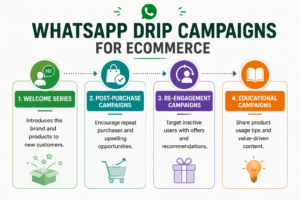
WhatsApp drip campaigns involve sending automated sequences of messages based on customer actions or timing.
Welcome Series — Introduces the brand and products to new customers.
Post-Purchase Campaigns — Encourage repeat purchases and upselling opportunities.
Re-Engagement Campaigns — Target inactive users with offers and recommendations.
Educational Campaigns — Share product usage tips and value-driven content.
These campaigns improve customer lifecycle marketing while strengthening brand relationships. The structure mirrors what works in email marketing drip sequences — the principles of timing, relevance, and value apply equally on WhatsApp.
WhatsApp Notifications for Ecommerce Stores
Transactional messaging is another powerful feature of ecommerce automation.
Brands use WhatsApp notifications for order confirmations, shipping updates, delivery notifications, payment confirmations, and return updates. These notifications improve trust and customer experience, reducing support queries and building confidence in the brand.
Best WhatsApp Marketing Practices for D2C Brands
1. Get Customer Consent
Always ensure opt-in permission before sending marketing messages.
2. Personalize Communication
Customers respond better to relevant and customized messages. The same logic applies to UGC campaigns — authentic, tailored content consistently outperforms generic creative.
3. Avoid Spam
Sending too many messages may reduce engagement and increase opt-outs.
4. Use Automation Strategically
Automation should improve customer experience, not replace human interaction completely.
5. Track Performance Metrics
Monitor open rates, click-through rates, conversion rates, repeat purchase rates, and customer retention metrics. For a structured approach to measuring what’s working across all channels, read our guide on how multi-channel attribution models improve marketing ROI.
WhatsApp Marketing Trends in India
WhatsApp marketing trends continue evolving rapidly as ecommerce brands adopt automation and conversational commerce strategies.
Key trends include AI-powered customer support, conversational shopping experiences, integrated payment systems, automated sales funnels, omnichannel customer engagement, and hyper-personalized campaigns.
Brands adopting these trends early may gain a competitive advantage. This aligns closely with the broader shift toward search everywhere optimization — customers today expect brands to be present and responsive across every platform they use.
How to Increase Repeat Sales with WhatsApp
Repeat customers are often more profitable than new customers. Brands focusing on retention marketing usually achieve stronger long-term growth.
Strategies to increase repeat purchases include sending personalized offers, creating loyalty campaigns, using reorder reminders, launching exclusive member discounts, running customer engagement campaigns, sharing new product alerts, and automating follow-up communication.
These strategies help strengthen customer relationships while supporting sustainable ecommerce growth. If you are also investing in paid acquisition to bring new customers in, a well-structured performance marketing strategy ensures WhatsApp retention efforts are working in tandem with your growth campaigns.
WhatsApp Marketing Examples for Ecommerce
Fashion Brands — Share back-in-stock alerts and personalized outfit recommendations.
Beauty Brands — Send skincare reminders and replenishment offers.
Health & Wellness Brands — Provide reorder notifications and educational content.
Grocery Brands — Send weekly deals and subscription reminders.
These use cases demonstrate how conversational marketing improves customer engagement and repeat purchases. D2C brands in these categories are also seeing strong results when WhatsApp is paired with social media marketing to drive initial awareness and then convert that audience into a direct messaging relationship.
Challenges in WhatsApp Marketing
While WhatsApp marketing offers many benefits, brands should also avoid common mistakes.
Common challenges include over-messaging customers, poor audience segmentation, lack of personalization, ignoring customer preferences, delayed responses, and a weak automation setup.
A balanced and customer-focused approach is essential. Brands that struggle with segmentation often benefit from working with a content marketing partner who can help map the right message to the right stage of the customer journey.
Conclusion
WhatsApp marketing for D2C brands in India is becoming one of the most effective ways to improve customer retention, engagement, and repeat purchases. From broadcasts and automation workflows to retargeting and personalized messaging, brands can build stronger customer relationships while increasing conversions.
As customer acquisition costs continue rising, focusing on retention marketing and customer lifecycle marketing is becoming increasingly important for sustainable growth. Brands that combine WhatsApp automation with strong performance marketing and content marketing strategies are best positioned for long-term ecommerce success.
Ready to build a WhatsApp marketing strategy that actually drives repeat sales? Get in touch with our team at Bismarck World Media for a free consultation.
Frequently Asked Questions
Why is WhatsApp marketing important for D2C brands in India?
WhatsApp offers direct customer communication, higher engagement rates, and personalized marketing opportunities that support customer retention and repeat sales.
How does WhatsApp automation help ecommerce brands?
WhatsApp automation helps brands manage customer communication efficiently through automated messages, cart recovery, notifications, and customer support workflows.
What is WhatsApp retargeting for ecommerce?
WhatsApp retargeting involves reconnecting with customers who interacted with products or abandoned carts but did not complete purchases.
Can WhatsApp help increase repeat purchases?
Yes, personalized offers, reorder reminders, loyalty campaigns, and customer engagement strategies can all help increase repeat purchases with WhatsApp.
What are the best WhatsApp marketing practices for D2C brands?
Brands should focus on personalization, customer consent, audience segmentation, automation, and consistent customer engagement. For a broader framework, explore how a structured digital marketing strategy ties all these elements together.