
Think about the last time someone in your family needed a new doctor. Did they flip through a phonebook? Call a friend? Probably not. They opened Google.
That’s the reality of healthcare today. Before a patient ever steps through your door, they’ve already researched your clinic online -reading reviews, comparing specialists, checking your website. If your practice doesn’t show up where patients are looking, a competitor’s does.
Healthcare digital marketing isn’t about chasing trends. It’s about making sure the right patients can find you at the exact moment they need your services. Whether you run a multi-specialty hospital, a diagnostic centre, or an independent practice, your online visibility directly affects how many patients walk through your doors.
This guide covers 12 strategies that actually work -practical, proven, and built around how patients search and make decisions today.
Why Online Visibility Matters More Than Ever for Healthcare Providers
Patients are more informed, more independent, and more digitally active than ever before. They research symptoms, compare hospitals, read doctor reviews, and even book appointments -all before making a single phone call.
When your healthcare organisation lacks a strong online presence, you don’t just miss website traffic. You miss patients who are actively searching for exactly what you offer.
Strong healthcare digital marketing helps you:
- Reach patients during the moments they’re making care decisions
- Build credibility before they’ve even spoken to your team
- Increase appointment bookings and reduce patient acquisition costs
- Strengthen trust through consistent, helpful content
- Outperform competitors in local and national search results
The organisations that consistently appear across search engines, directories, and social platforms aren’t just lucky -they’ve invested in the right strategies.
12 Proven Healthcare Digital Marketing Strategies
1. Invest in Healthcare SEO
If there’s one strategy that delivers long-term, compounding returns for healthcare providers, it’s Search Engine Optimisation (SEO).
Patients search for terms like:
- Best cardiologist near me
- Orthopaedic hospital in Mumbai
- Diabetes treatment clinic
- Paediatric specialist near me
A well-executed healthcare SEO strategy helps your website rank for these searches so patients find you -not a competitor. It includes:
- Keyword research targeting how patients actually phrase their searches
- On-page optimisation of service pages, doctor profiles, and landing pages
- Technical SEO to ensure your site loads fast and is crawlable
- Local SEO to dominate searches in your city or locality
- Content creation that answers real patient questions
- Ethical link building to grow your domain authority
Most SEO campaigns begin showing measurable results within 3–6 months. Unlike paid ads, the traffic SEO delivers doesn’t stop the moment your budget does.
Helpful resource: How Bismarck World Media approaches SEO for competitive healthcare markets →
2. Optimise Your Google Business Profile
For any healthcare provider serving a local community, Google Business Profile (GBP) is non-negotiable.
When someone searches “ENT specialist near me” or “hospital in Andheri”, the results that appear first -before the organic listings -are Google Business profiles. These local results often determine which clinic gets the appointment request.
Make sure your profile includes:
- Accurate clinic name, address, and phone number
- Updated consultation hours (including holidays)
- High-quality photos of your facility and team
- A clear list of services and specialties
- A direct link to your online appointment booking
- Regular posts and updates to keep your profile active
Encourage satisfied patients to leave honest reviews -Google factors review quantity and quality into local rankings.
3. Create Patient-Focused Educational Content
Patients don’t just search for clinics. They search for answers. “What are the symptoms of diabetes?” “How long is the recovery after knee replacement?” “Is it normal to have back pain at 30?”
By creating educational content that addresses these questions, your healthcare brand builds trust before a patient has even considered booking an appointment.
Effective content types include:
- Treatment and procedure guides (e.g., What to expect before and after cataract surgery)
- Disease awareness articles (e.g., Early warning signs of thyroid disorders)
- Preventive health tips (e.g., How to maintain heart health in your 40s)
- Recovery guides for common procedures
- FAQ pages addressing patient concerns by specialty
This is where content marketing and SEO work together -your content brings in patients through organic search while positioning your team as trusted experts.
4. Strengthen Local SEO
The vast majority of healthcare searches have local intent. Patients want a doctor near them, a hospital in their city, and a lab in their neighbourhood.
Local SEO ensures your clinic appears when those searches happen. Key local SEO tactics for healthcare include:
- Location-specific landing pages for each city, locality, or branch
- Consistent NAP data (Name, Address, Phone) across all online listings
- Local citations in directories like Practo, Justdial, and Sulekha
- Healthcare directory listings (ILS, Credihealth, etc.)
- Schema markup to help Google understand your location, services, and hours
For clinics with multiple branches, each location should have its own optimised page and Google Business profile.
5. Improve Your Website’s User Experience
Your website is often a patient’s first real impression of your practice. If it’s slow, cluttered, or hard to navigate, they leave. And they probably don’t come back.
Common website problems that hurt both patient experience and search rankings:
- Slow load times (especially on mobile)
- Confusing navigation that buries key services
- Outdated information about doctors or services
- No clear call-to-action or appointment booking option
- Poor mobile design
A well-designed healthcare website loads fast, makes it easy to find doctors and services, and converts visitors into appointment bookings. If your site is due for a refresh, it’s worth investing in -both for patients and for SEO performance.
6. Build Trust Through Patient Reviews
In healthcare, trust is everything. And today, trust starts online.
Patients read reviews before choosing a provider. A clinic with 200 positive Google reviews will almost always attract more appointments than one with 20 -even if the clinical quality is identical.
Encourage reviews by:
- Asking satisfied patients directly (in person or via follow-up message)
- Making the review process easy with a direct Google review link
- Responding professionally to all reviews -positive and negative
- Listing on healthcare-specific platforms like Practo, where patients actively compare providers
Authentic reviews also strengthen your local SEO -Google treats them as a signal of credibility and relevance.
7. Build a Strong Social Media Presence
Social media isn’t just for consumer brands. Healthcare organisations that show up consistently on social platforms build familiarity, trust, and reach -especially with preventive care audiences.
Effective healthcare social media marketing includes:
- Sharing health education content (tips, myths, awareness)
- Highlighting your team’s expertise and behind-the-scenes moments
- Promoting health camps, screenings, and awareness campaigns
- Running condition-specific awareness series (e.g., World Diabetes Day content)
- Showcasing patient success stories (with consent)
Facebook and Instagram work well for patient education and community building. LinkedIn is effective for specialist doctors building professional authority. YouTube is powerful for procedure explainers and doctor introductions.
Consistency matters more than frequency -post less often if needed, but show up regularly.
8. Diversify Your Content Marketing
Blogs are just one format. Patients engage with information in different ways -some prefer watching, some reading, some scanning.
A strong healthcare content marketing strategy includes:
- Short explainer videos on common conditions and treatments
- Infographics for preventive care tips (great for social sharing)
- Webinars or live Q&A sessions with specialist doctors
- Patient guides that walk through treatment journeys
- Case studies showing patient outcomes
Diversifying your content means reaching more people across more channels -and giving search engines more reasons to surface your brand.
9. Use Data and Analytics to Guide Every Decision
Healthcare marketing without data is just guesswork. The organisations that improve fastest are the ones that track, analyse, and act on their numbers.
Key metrics to monitor include:
- Organic search traffic and keyword rankings
- Website conversion rate (visits → appointment enquiries)
- Cost per lead and cost per patient acquisition
- Social media engagement and reach
- Google Ads return on ad spend (ROAS) and cost per click
Use Google Analytics 4, Google Search Console, and your ad platform dashboards to understand what’s working and what needs attention. Monthly reviews should be standard practice -not a quarterly afterthought.
10. Invest in Paid Search Advertising
SEO is your long-term engine. Paid search (SEM) is your immediate accelerator.
Google Ads can place your clinic at the top of search results for high-intent queries like:
- The emergency dental clinic is open now
- Cosmetic surgery consultation Mumbai
- Best orthopaedic specialist near me
Unlike organic SEO, paid ads can generate appointment enquiries from day one. For healthcare brands entering a new market, launching a new service, or running a time-sensitive campaign, paid search and performance marketing is invaluable.
The key is targeting the right keywords, controlling your budget carefully, and tracking every lead back to actual appointments booked.
11. Prioritise Mobile Optimisation
Over 70% of healthcare-related searches now happen on smartphones. If your website isn’t built for mobile, you’re losing patients before they’ve even read a word.
A mobile-optimised healthcare website should:
- Load in under 3 seconds on a standard mobile connection
- Be fully readable without zooming or horizontal scrolling
- Have click-to-call buttons for instant contact
- Make appointment booking as simple as possible (ideally 2–3 taps)
Mobile optimisation also directly affects Google rankings -Google uses mobile-first indexing, meaning your mobile site is what Google evaluates when deciding where to rank you.
12. Establish Thought Leadership
Patients choose healthcare providers they trust. One of the most powerful ways to build that trust at scale is to consistently share genuine expertise.
Thought leadership for healthcare brands can look like:
- Expert articles by specialist doctors on condition management
- Opinion pieces on healthcare trends and patient care improvements
- Research-backed content on treatment advancements
- Speaking at industry conferences and community health events
- Media contributions to health publications
When your doctors are visible authorities -not just names on a website -patients are more likely to choose your clinic over a faceless competitor.
Common Mistakes That Hold Healthcare Brands Back
Even well-resourced healthcare organisations struggle online because of avoidable errors:
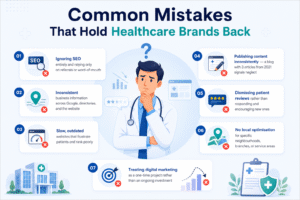
- Ignoring SEO entirely and relying only on referrals or word-of-mouth
- Inconsistent business information across Google, directories, and the website
- Slow, outdated websites that frustrate patients and rank poorly
- Publishing content inconsistently -a blog with 3 articles from 2021 signals neglect
- Dismissing patient reviews rather than responding and encouraging new ones
- No local optimisation for specific neighbourhoods, branches, or service areas
- Treating digital marketing as a one-time project rather than an ongoing investment
Avoiding these mistakes doesn’t require a huge budget. It requires consistency, the right strategy, and a team that understands how healthcare patients search and decide.
Frequently Asked Questions
What is healthcare digital marketing?
Healthcare digital marketing refers to online strategies used by hospitals, clinics, and medical practices to attract patients, build trust, and improve visibility. It includes SEO, content marketing, social media, paid advertising, local search optimisation, and patient review management.
Why is SEO important for healthcare providers?
SEO helps healthcare websites rank higher in Google search results, making it easier for patients to find your services when they need them. Unlike paid ads, organic SEO delivers sustainable traffic without ongoing ad spend.
How can a hospital improve its online visibility?
Hospitals can improve online visibility through a combination of healthcare SEO, Google Business Profile optimisation, educational content creation, local directory listings, patient reviews, and paid search advertising.
What is local SEO, and why does it matter for clinics?
Local SEO helps your clinic appear in searches for healthcare providers in a specific area -like “gynaecologist in Bandra” or “paediatric clinic in Powai”. For most clinics, local patients are their primary audience, making local SEO one of the highest-ROI activities available.
How long does healthcare SEO take to show results?
Most healthcare SEO campaigns show measurable keyword movement within 60–90 days, with significant organic traffic growth typically visible between months 3–6. Timelines vary based on how competitive your market is, your website’s current authority, and the quality of your content.
What types of content work best for healthcare marketing?
Blog articles, treatment guides, FAQ pages, explainer videos, and infographics all perform well for healthcare. The best content addresses real patient questions in clear, reassuring language -avoiding jargon wherever possible.
Do healthcare providers need to be on social media?
Yes. Social media helps healthcare brands build familiarity and trust, reach patients beyond active search moments, and share health education that positions your team as genuine experts. Platforms like Instagram, Facebook, and YouTube are particularly effective for patient engagement.
Conclusion
The patients you want to serve are already online -searching, comparing, and making decisions. The question is whether they’re finding you or a competitor.
Improving your online visibility doesn’t happen overnight, but it does happen when you commit to the right mix of strategies: strong healthcare SEO, locally optimised content, genuine patient reviews, educational content, and data-driven decision-making.
Healthcare digital marketing isn’t optional anymore. It’s one of the most direct paths between your expertise and the patients who need it.
If you’re ready to build a healthcare digital marketing strategy that actually delivers measurable patient growth, talk to the team at Bismarck World Media →
Related Services: