
Your customer is standing in their kitchen, hands full, and asks their phone: “Hey Google, find the best web design company near me.” In under two seconds, Google Assistant reads one answer aloud — and moves on. There is no page two. There is no second chance.
That is the reality of voice search in 2026. With over 8.4 billion voice-enabled devices in use globally and 157 million Americans expected to use voice assistants by the end of this year, the way people discover businesses has fundamentally changed. If your business isn’t investing in voice search optimization for businesses, you’re handing customers directly to your competitors. This guide breaks down everything you need to know — from the key ranking factors to a practical strategy you can implement right away.
Why Voice Search SEO Is No Longer Optional for Businesses
Voice search has quietly crossed from novelty into necessity. Speaking is nearly three times faster than typing on a mobile device, which explains why more than 27% of mobile users now rely on voice to search online. Add smart speakers, in-car assistants, and AI-powered devices into the mix, and you have a search channel that touches virtually every moment of the customer journey — commuting, cooking, shopping, and beyond.
What makes voice search marketing for companies uniquely urgent is the winner-takes-all nature of results. Unlike a standard Google search that shows ten blue links, a voice assistant delivers one answer. Securing that position is worth more than ranking second through tenth combined. If you’re not optimising for how people actually talk — not just how they type — you’re already behind.
Nearly 76% of voice searches carry local intent. Someone is looking for a business, service, or product nearby — and they’re ready to act. That makes local SEO for voice search one of the highest-ROI strategies any business can invest in, with 76% of local voice searchers visiting a business within 24 hours of their query.
How Voice Search Works: Alexa, Siri & Google Assistant
Before building your voice SEO strategy, it helps to understand how each major assistant sources its answers — because they don’t all work the same way.
Google Assistant pulls primarily from Google’s search index, featured snippets, and Google Business Profiles. It reads featured snippets aloud 40–60% of the time, making position zero the single most valuable piece of real estate in voice SEO.
Apple Siri relies on Bing, Apple Maps, and Yelp for most queries. To get found on Siri, businesses need a strong Bing presence, accurate Apple Maps listing, and a healthy Yelp profile with good reviews.
Amazon Alexa also uses Bing and Yelp as primary data sources for local queries. Maintaining an updated Yelp listing and consistent business information across directories is the fastest way to improve your Alexa voice search visibility.
Key Voice Search Ranking Factors in 2026
Understanding the voice search ranking factors that actually matter helps you focus your efforts where they’ll have the most impact.
Conversational, Question-Based Content:
Voice queries average 29 words — far longer than the 4–6 word typed search. Your content needs to answer full questions naturally. Think “How do I optimize my website for voice search?” rather than just “voice search optimization.” This is the foundation of conversational SEO optimization: write the way people actually talk.
Featured Snippets (Position Zero):
Around 50% of voice search results are pulled directly from Google’s featured snippet. Structure your content with a direct, 40–60 word answer immediately below a question-format heading. This is your fastest and most reliable path to ranking on Google Assistant search results.
Page Speed & Mobile Performance:
Voice search results load 52% faster than the average web page. If your site is slow on mobile, you’re disqualified before the race begins. Mobile voice search optimization starts with ensuring your pages meet Google’s Core Web Vitals and load in under three seconds on every device.
Schema Markup & Structured Data:
Schema markup is the language that helps voice assistants understand your content. Implementing FAQ schema, LocalBusiness schema, and HowTo schema makes your pages eligible for rich results and spoken answers. It remains one of the most underused smart assistant SEO tactics among small and mid-sized businesses.
Google Business Profile Completeness:
For local voice search ranking, your Google Business Profile is your most important asset. Businesses with complete, accurate profiles are 70% more likely to appear in location-based voice queries. Fill every field, add updated photos, respond to reviews, and post regularly to maintain freshness signals.
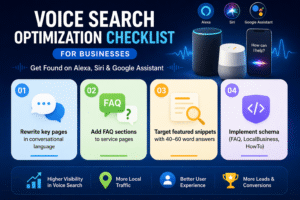
Voice Search Optimization Checklist for Businesses
Use this checklist to audit and improve your current presence across Alexa, Siri, and Google Assistant:
- Rewrite key pages to answer common customer questions in plain, conversational language
- Add FAQ sections to service pages, targeting exact questions people ask aloud
- Target featured snippets with concise 40–60 word answers below question-format headings
- Implement FAQ schema, LocalBusiness schema, and HowTo schema on relevant pages
- Ensure site speed is under 3 seconds and passes Core Web Vitals on mobile
- Complete and verify your Google Business Profile with accurate name, address, and phone
- Build consistent citations across Yelp, Bing Places, Apple Maps, and local directories
- Optimize for “near me” and location-specific long-tail voice queries
- Monitor question-format queries in Google Search Console on a regular basis
- Test your content using actual voice assistant queries every quarter
Why Is My Business Not Showing Up in Voice Search?
This is the most common question from businesses exploring voice search SEO services. The answer almost always comes down to one of these issues:
No featured snippet — content isn’t structured for position zero. Fix it by adding concise Q&A sections with FAQ schema.
Slow mobile site — page speed disqualifies the result. Improve Core Web Vitals and compress images.
Incomplete Google Business Profile — missing local signals. Fill every field, add photos, and actively collect reviews.
No conversational content — pages target typed keywords, not spoken queries. Rewrite using natural language and full questions.
No schema markup — voice assistants can’t parse your content structure. Add LocalBusiness, FAQ, and HowTo schema.
If your website is not ranking in voice search, addressing even two or three of these issues can produce a significant and relatively quick improvement in visibility.
Voice Search Trends 2026: What’s Changing
The biggest voice search trend of 2026 is the convergence of traditional voice assistants with generative AI platforms. When a user asks Google Assistant a question and when someone queries ChatGPT, the experience feels increasingly similar — and your content needs to work across both.
This shift has given rise to Answer Engine Optimization (AEO) and Generative Engine Optimization (GEO), two disciplines sitting alongside traditional SEO that are rapidly becoming essential for businesses that want to stay visible. Content that answers questions directly, demonstrates genuine expertise, and is structured clearly for machines will perform well whether the query comes through a smart speaker, a phone, or an AI chat interface.
Voice commerce is also accelerating. An estimated 38.8 million Americans already use smart speakers for shopping-related activities. Businesses in e-commerce, hospitality, and local services should be building voice-friendly calls to action — “Order now,” “Book a consultation,” “Get directions” — directly into their content and product pages.
FAQs: Voice Search Optimization for Businesses
What is voice search optimization for businesses?
Voice search optimization for businesses is the process of adapting your website, local listings, and technical setup so that voice assistants — Google Assistant, Alexa, and Siri — can find and deliver your business as the spoken answer to relevant customer queries. It covers conversational content, schema markup, featured snippet targeting, and local SEO.
How do I get found on Alexa voice search?
Ensure your business has a complete Yelp profile and consistent presence on Bing Places, since Alexa draws heavily from Bing and Yelp for local queries. Using conversational language on your website and structuring content with clear Q&A formats also significantly improves your chances of being selected as Alexa’s answer.
How do I rank on Google Assistant search results?
Focus on winning featured snippets for question-based queries in your niche. Structure pages with a direct 40–60 word answer below a question-format heading, implement FAQ schema, maintain a fully optimized Google Business Profile, and ensure your site loads fast on mobile.
What are the most important voice search ranking factors?
The key factors are: featured snippet ownership, page speed and mobile performance, structured data and schema markup, Google Business Profile completeness, and conversational content that matches natural spoken language. Local authority and review quality are also significant for location-based queries.
How much does voice search optimization cost?
Voice search optimization cost depends on your existing SEO foundation, website size, and target market. It can range from a one-time technical and content audit to an ongoing monthly retainer with a voice SEO consultant or agency. Businesses in India — including those looking for a voice search agency in Mumbai — can often access high-quality voice SEO services at competitive rates. Contact us for a tailored quote.
Is voice search SEO different from regular SEO?
Yes. Voice queries are 3–5 words longer, phrased as full questions, and dominated by local and conversational intent. Voice search also delivers a single result rather than a list of links, making competition more selective. While the technical foundations overlap, voice SEO requires additional conversational content strategy, schema markup, and featured snippet optimization on top of regular SEO work.
Should I hire a voice search optimization agency?
If you serve local customers or a mobile-first audience, working with a voice SEO company or consultant can accelerate results and help you avoid common mistakes. Look for experience in local SEO, structured data, and content strategy. A voice SEO consultant for business can tailor the approach to your specific industry, audience, and goals.