
Why AI Overviews Have Changed SEO Forever
If you’re wondering how to rank in AI Overviews, you’re not alone. Google’s AI-powered search experience has fundamentally changed how content is discovered, ranked, and cited. Traditional rankings alone are no longer enough visibility inside AI-generated answers is now the new SEO frontier.
AI Overviews (formerly part of Google SGE) pull concise answers directly into search results, often reducing clicks to traditional listings. This means brands that appear inside AI Overviews gain disproportionate authority, trust, and organic visibility.
This guide explains what actually works for ranking in AI Overviews, based on observable data, live SERP behavior, and real-world patterns not speculation.
What Are AI Overviews and How Do They Work?
AI Overviews are Google’s generative search summaries that combine information from multiple trusted sources into a single, AI-written response.
Instead of ranking ten blue links, Google:
- Analyzes search intent
- Identifies authoritative entities
- Pulls structured, factual content
- Generates a synthesized answer
Understanding how AI Overviews choose sources is the foundation of modern generative search SEO.
How AI Overviews Choose Sources
Based on large-scale SERP analysis and studies (including research shared by Ahrefs), Google AI Overviews tend to cite pages that meet the following criteria:
1. Strong Topical Authority
Pages that deeply cover a subject not surface-level content are more likely to be referenced.
2. Clear Entity Signals
AI prefers content with:
- Well-defined entities
- Consistent terminology
- Contextual relevance across the site
This is where GEO SEO strategy becomes critical.
3. Existing SERP Trust
Most AI-cited pages already:
- Rank in the top 10
- Appear in featured snippets
- Earn backlinks from authoritative sources
AI Overviews do not “discover” random pages, they amplify trusted ones.
Core AI Search Ranking Factors You Must Optimize
To succeed in SEO for AI search, you must optimize beyond keywords.
1. Intent-Matched Content Structure
AI favors content that:
- Directly answers questions
- Uses logical headings
- Avoids fluff and filler
2. Semantic Depth Over Keyword Density
Rather than repeating keywords, AI evaluates:
- Context
- Concept relationships
- Entity completeness
This is the backbone of AI search ranking factors.
3. Fact-First Writing Style
AI prefers:
- Declarative sentences
- Clear definitions
- Data-supported claims
AI Overviews Optimization: What Actually Moves the Needle
Use an “Answer-First” Content Model
Every key section should:
- Start with a direct answer
- Expand with explanation
- End with actionable insight
This aligns perfectly with AEO for AI search.
Optimize for Google AI Overviews SEO with Formatting
Use:
- Short paragraphs (2–3 lines)
- Bullet points
- Clear subheadings
- FAQ blocks
This improves scannability for both users and AI systems.
Google SGE Optimization vs Traditional SEO
|
Traditional SEO |
AI Overview SEO |
|
Keyword-focused |
Entity-focused |
|
Page-level ranking |
Source-level trust |
|
Click-driven |
Citation-driven |
| SERP position |
AI inclusion |
The Role of GEO SEO Strategy in AI Rankings
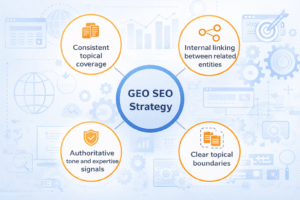
GEO (Generative Engine Optimization) focuses on how AI systems understand and reuse content.
Key GEO signals include:
- Consistent topical coverage
- Internal linking between related entities
- Authoritative tone and expertise signals
- Clear topical boundaries
This is why thin blogs rarely appear in AI Overviews.
Practical Steps to Rank in AI Overviews
Step 1: Target AI-Friendly Queries
Focus on:
- “How to…”
- “What is…”
- “Why does…”
- Comparison-based searches
These queries trigger AI Overviews most often.
Step 2: Re-optimize Existing High-Ranking Pages
Pages already ranking in the top 10 have the highest probability of AI inclusion.
Enhance them with:
- Clear definitions
- Structured FAQs
- Updated data
- Entity clarity
Step 3: Strengthen E-E-A-T Signals
AI Overviews heavily rely on:
- Experience
- Expertise
- Authoritativeness
- Trustworthiness
Add:
- Author bios
- Source citations
- Updated timestamps
Common Myths About Ranking in AI Overviews
“AI Overviews replace SEO”
Reality: AI Overviews depend on SEO
“Only big brands get cited”
Reality: Niche authority sites appear frequently
“Keywords don’t matter anymore”
Reality: Keywords guide intent – entities drive ranking
The Future of Generative Search SEO
AI Overviews are not a temporary feature they represent Google’s long-term vision.
Winning strategies combine:
- SEO for AI search
- AEO for conversational queries
- GEO SEO strategy for generative systems
Brands that adapt now will dominate visibility as AI search expands.
Final Thoughts: Ranking in AI Overviews Is a Strategic Advantage
Learning how to rank in AI Overviews is no longer optional, it’s essential. As Google continues expanding generative search, brands that optimize for AI Overviews optimization, AEO, and GEO SEO strategy will capture visibility others lose.
This isn’t the end of SEO, it’s the evolution of it.
FAQs:
1. How to rank in AI Overviews faster?
Focus on improving existing top-ranking pages with clearer answers, better structure, and stronger entity signals.
2. Does ranking #1 guarantee inclusion in AI Overviews?
No. AI Overviews prioritize authority and clarity, not just position.
3. What content type works best for AI Overviews?
Educational, fact-based, and well-structured content performs best.
4. Is Google SGE optimization different from SEO?
Yes. Google SGE optimization focuses more on entities, answers, and trust than traditional keyword ranking.
5. Can small websites rank in AI Overviews?
Yes. Niche expertise and topical depth often outperform large generic sites.