
Google Search is evolving faster than ever. Traditional blue links are no longer the only way users discover information. With the introduction of Google AI Overviews, search results have become more conversational, contextual, and powered by generative AI. This shift has changed how businesses approach SEO, making Google AI Overviews SEO an essential part of every digital marketing strategy.
Instead of simply ranking web pages, Google now analyzes multiple trusted sources to generate AI-powered summaries that answer users’ questions instantly. For businesses, marketers, and SEO professionals, this means that creating content for traditional search alone is no longer enough. You must also optimize your website for AI Search Optimization, Answer Engine Optimization (AEO), and Generative Engine Optimization (GEO) to increase your chances of appearing in Google’s AI-generated results. This connects closely to the broader shift toward Search Everywhere Optimization, where visibility now spans far beyond the traditional search results page.
In this guide, you’ll learn how Google AI Overviews work, what influences AI visibility, and the proven strategies that help websites earn greater visibility in AI-powered search while continuing to improve their organic rankings.
Google AI Overviews use generative AI to provide quick, comprehensive answers at the top of search results by combining information from multiple trusted sources. To improve your visibility in these AI-generated summaries, focus on creating helpful, people-first content that aligns with search intent, demonstrates E-E-A-T, and covers topics comprehensively. Implement structured data, build topical authority through interconnected content, maintain strong technical SEO, and answer user questions clearly using conversational language. Businesses that combine traditional SEO with Answer Engine Optimization (AEO), Generative Engine Optimization (GEO), and AI Search Optimization are better positioned to appear in Google’s evolving AI search experiences and attract high-quality organic traffic.
Why Google AI Overviews Matter
Google AI Overviews represent one of the biggest changes to search in the past decade. Instead of presenting only a list of links, Google now delivers AI-generated summaries that combine information from multiple high-quality sources.
For users, this creates a faster and more informative search experience. For businesses, it changes how visibility is earned.
Rather than focusing solely on keyword rankings, modern SEO now emphasizes:
- Creating genuinely helpful content
- Demonstrating expertise and trustworthiness
- Answering questions clearly
- Building topical authority
- Optimizing technical SEO
- Structuring information for AI systems
Businesses that adapt early are more likely to gain visibility as AI-powered search continues to expand.
What Are Google AI Overviews?
Google AI Overviews are AI-generated summaries that appear at the top of search results for many informational and complex queries. Instead of requiring users to visit several websites, Google provides a concise overview while citing relevant sources that support the answer. You can read Google’s own explanation of how the feature works in its Search Central documentation on AI features.
Unlike traditional featured snippets, AI Overviews synthesize information from multiple trusted pages rather than relying on a single source.
For example, a search such as:
“How to rank in Google AI Overviews”
may display:
- an AI-generated explanation,
- recommended optimization strategies,
- supporting references,
- and links to authoritative websites.
This creates a richer search experience while still encouraging users to explore trusted sources for more detailed information.
How Do Google AI Overviews Work?
Google’s AI systems evaluate content using a combination of traditional ranking signals and modern AI understanding.
Instead of matching keywords alone, Google interprets:
Search Intent
Understanding what users actually want remains the foundation of SEO. AI prioritizes pages that completely satisfy the user’s question rather than simply repeating keywords.
For example, someone searching for:
“Google AI Search”
is usually looking to understand:
- what it is,
- how it works,
- how it affects SEO,
- and how businesses should adapt.
Content that addresses all of these aspects naturally performs better than pages targeting only one keyword variation.
Semantic Understanding
Modern search engines understand relationships between topics instead of individual keywords. This is where Semantic SEO becomes increasingly valuable.
Instead of repeating “Google AI Overviews SEO” multiple times, your content should naturally include related concepts such as:
- AI Search Optimization
- AI Search Results
- AI Search Ranking Factors
- Entity SEO
- Helpful Content
- Structured Data
- Conversational Search
- AI Visibility SEO
This helps Google understand the broader topic your page covers.
Entity Recognition
Google increasingly relies on Entity SEO. Entities are identifiable concepts like:
- Search Engine Optimization
- Artificial Intelligence
- Schema Markup
- Digital Marketing
When your content clearly explains how these entities relate to one another, Google’s AI can better understand your expertise.
Why AI Overviews Are Changing SEO
Traditional SEO focused heavily on rankings. Modern SEO focuses on visibility.
A website may still rank first organically while another page is referenced inside Google’s AI Overview. This means success is no longer measured only by position one.
Businesses should optimize for:
- Organic rankings
- AI Search Results
- Featured Snippets
- People Also Ask
- Voice Search
- AI Mode
- Zero-Click Search visibility
The goal is to become the most helpful source across every search experience, including newer surfaces like ChatGPT, where visibility works differently than in traditional Google results. If you’re weighing where to focus your effort, our comparison of ChatGPT vs Google AI Overviews breaks down which platform gives your content more reach.
Google AI Overviews SEO Ranking Factors
Although Google hasn’t published a separate ranking algorithm specifically for AI Overviews, current guidance suggests many established SEO best practices remain essential.
1. Helpful, People-First Content
Content should solve real problems. Avoid writing solely for search engines. Instead:
- answer questions directly,
- explain concepts clearly,
- provide examples,
- Keep information updated.
Helpful content consistently performs better across AI-powered search experiences. This is also the foundation of a strong content marketing strategy. AI visibility and content quality are no longer separate disciplines.
2. E-E-A-T Signals
Experience, Expertise, Authoritativeness, and Trustworthiness (E-E-A-T) are increasingly important for AI-generated search.
Demonstrate expertise by:
- citing reputable sources,
- including first-hand insights where appropriate,
- maintaining accurate information,
- showcasing the author’s expertise,
- Updating content regularly.
Trustworthy websites are more likely to become reliable sources for AI-generated responses.
3. Topical Authority
Rather than publishing isolated articles, build clusters around a topic. For example, if you’re writing about AI search, support it with related content such as:
- AI Search Optimization Guide
- Answer Engine Optimization Explained
- Generative Engine Optimization Strategies
- Google AI Mode SEO
- Schema Markup for AI Search
- Future of Search Engines
- Technical SEO Best Practices
A strong content ecosystem signals subject-matter expertise. For a deeper look at how this works in practice, see our guide on building topical authority to dominate competitive niches.
4. Strong Technical SEO
AI systems still rely on solid technical foundations. Prioritize:
- Fast-loading pages
- Mobile responsiveness
- HTTPS security
- Clean site architecture
- XML sitemap
- Internal linking
- Crawlability
- Indexability
Technical excellence ensures your content can be discovered, understood, and surfaced effectively.
5. Search Intent Alignment
Every article should satisfy a clear search intent. For informational searches:
- explain concepts,
- compare solutions,
- answer related questions,
- Include actionable advice.
Avoid writing content that leaves important questions unanswered.
Structured Data and Schema Markup
Schema Markup helps search engines understand your content more effectively. While schema doesn’t guarantee inclusion in AI Overviews, it provides valuable context that can improve how Google interprets your pages.
Useful schema types include:
- Article
- FAQ
- Breadcrumb
- Organization
- Person
- WebPage
- HowTo (where appropriate)
Structured data also strengthens your eligibility for rich results and improves content organization.
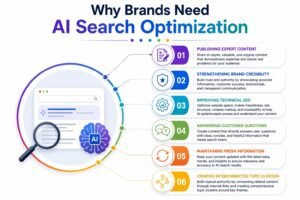
Why Brands Need AI Search Optimization
AI-powered search rewards brands that consistently publish authoritative, trustworthy, and user-focused content. Instead of chasing algorithm updates, businesses should invest in long-term authority by:
- publishing expert content,
- strengthening brand credibility,
- improving technical SEO,
- answering customer questions,
- maintaining fresh information,
- and creating interconnected topic clusters.
This approach benefits both traditional rankings and AI-driven search experiences.
Appearing in Google’s AI-generated results isn’t about discovering a secret ranking hack; it’s about consistently publishing content that demonstrates expertise, satisfies user intent, and is easy for search engines to understand.
Here are the most effective strategies to improve your visibility in Google AI Overviews SEO.
How to Optimize for Google AI Overviews: 5 Core Strategies
1. Create People-First, Helpful Content
Google’s AI prioritizes content that genuinely answers users’ questions. Before writing, ask yourself:
- Does this article solve a real problem?
- Is it more comprehensive than competing pages?
- Does it provide practical examples and actionable advice?
- Would a reader find value even if search engines didn’t exist?
Instead of chasing keywords, focus on delivering a complete solution. This approach aligns with Google’s Helpful Content principles and improves your chances of appearing in AI Search Results.
2. Match Search Intent Precisely
Every search query has an underlying intent. Understanding that intent is one of the strongest AI Search Ranking Factors.
For example, someone searching “How to rank in Google AI Overviews” expects:
- An explanation of AI Overviews
- Ranking strategies
- Technical SEO recommendations
- Common mistakes
- Practical implementation tips
When your content satisfies all related questions within a single page, Google is more likely to consider it a valuable resource.
3. Build Topical Authority
Publishing one article about AI search isn’t enough. Create a connected ecosystem of content that demonstrates expertise across the topic. Examples include:
- AI Search Optimization Guide
- Answer Engine Optimization Explained
- Generative Engine Optimization vs Traditional SEO
- Google AI Mode SEO Best Practices
- Schema Markup for AI Search
- Future of AI-Powered Search
This interconnected content strengthens your site’s topical authority and signals expertise.
4. Strengthen E-E-A-T
Google evaluates whether your content reflects real expertise and trustworthiness. Improve your E-E-A-T by:
- Publishing original insights and research
- Including author information and credentials
- Citing reputable industry sources
- Updating content regularly
- Sharing practical experience and case studies
- Maintaining transparent contact and business information
For agencies like Bismarck World Media, showcasing successful SEO campaigns, client success stories, and industry expertise helps build credibility. You can see examples of this in our case studies.
5. Optimize for Conversational Queries
AI-powered search is designed to answer natural language questions. Instead of focusing only on short keywords, optimize for conversational searches like:
- What are Google AI Overviews?
- How do Google AI Overviews work?
- How can businesses optimize for AI search?
- What is AI Search Optimization?
- Does SEO still matter in the AI era?
Using clear headings and concise answers increases your chances of appearing in AI-generated summaries. This same principle applies directly to voice search optimization, since voice assistants and AI Overviews both favor natural, question-based content.
What Is Answer Engine Optimization (AEO)?
Answer Engine Optimization (AEO) focuses on creating content that directly answers user questions in a structured and concise format.
To improve AEO:
- Answer questions immediately after each heading.
- Use bullet points and numbered lists where appropriate.
- Include FAQ sections.
- Add schema markup.
- Keep explanations clear and conversational.
AEO complements traditional SEO by helping content surface in AI-powered search experiences and voice search results.
What Is Generative Engine Optimization (GEO)?
Generative Engine Optimization (GEO) is the practice of optimizing content for AI-driven search platforms that generate responses instead of simply listing links.
Unlike traditional SEO, GEO emphasizes:
- Comprehensive topic coverage
- Contextual relevance
- Entity relationships
- Structured information
- Trustworthy sources
- Natural language
Businesses investing in GEO today are better positioned for the future of search.
Google AI Mode SEO
Google continues to expand AI-powered search experiences through AI Mode and conversational search features. To prepare:
- Write naturally.
- Organize content with descriptive headings.
- Cover related subtopics comprehensively.
- Use semantic keywords instead of repeating the same phrase.
- Keep content updated to reflect new developments.
These practices improve both user experience and AI comprehension.
Common Mistakes That Reduce AI Visibility
Avoid these common SEO mistakes:
- Publishing thin or duplicate content
- Ignoring search intent
- Overusing keywords
- Neglecting internal linking
- Using outdated statistics
- Failing to update older articles
- Ignoring technical SEO issues
- Publishing without structured headings
- Lacking author credibility
- Forgetting schema markup
Consistency and quality are far more effective than shortcuts.
Google AI Overviews SEO Checklist
Before publishing any article, ensure that it includes:
- ✔ A clear primary keyword
- ✔ Comprehensive topic coverage
- ✔ Helpful, original insights
- ✔ Strong E-E-A-T signals
- ✔ Optimized title and meta description
- ✔ Internal links to related content
- ✔ Relevant external references
- ✔ FAQ section
- ✔ Schema Markup
- ✔ Mobile-friendly design
- ✔ Fast page speed
- ✔ Clear heading hierarchy
- ✔ Updated information
- ✔ Natural keyword placement
- ✔ Strong readability
The Future of AI Search
AI-powered search will continue evolving, but the core principles of great SEO remain unchanged.
Businesses that focus on creating valuable content, building topical authority, and maintaining technical excellence will continue to earn visibility regardless of future algorithm updates.
Rather than optimizing solely for rankings, brands should optimize for understanding, trust, and user satisfaction.
As AI becomes more integrated into search experiences, businesses that invest in long-term authority will be better positioned to attract qualified traffic and generate sustainable growth.
Conclusion
Google AI Overviews are redefining how people discover information online, making it essential for businesses to adapt their SEO strategies. Instead of focusing solely on rankings, marketers must prioritize creating helpful, trustworthy, and well-structured content that addresses user intent and demonstrates expertise.
By combining traditional SEO with AI Search Optimization, Answer Engine Optimization (AEO), and Generative Engine Optimization (GEO), businesses can improve their visibility across AI-powered search experiences while continuing to strengthen their organic performance.
For brands looking to stay ahead, success will come from consistently publishing people-first content, strengthening technical SEO, building topical authority, and earning trust, not from chasing shortcuts.
- Google AI Overviews are transforming how users discover information.
- Traditional SEO alone is no longer enough.
- Focus on Google AI Overviews, SEO, and AI-first search strategies.
- Create helpful, people-first content that fully satisfies user intent.
- Demonstrate strong E-E-A-T through expertise and credibility.
- Build topical authority with related content clusters.
- Optimize for conversational queries and Answer Engine Optimization.
- Implement schema markup and strengthen Entity SEO.
- Improve technical SEO, crawlability, and page experience.
- Regularly update content to maintain relevance.
- Prioritize quality over keyword stuffing.
- Combine SEO, AEO, and GEO for long-term success.
Frequently Asked Questions
- What are Google AI Overviews?
Google AI Overviews are AI-generated summaries that appear in Google Search, providing concise answers by combining information from multiple trusted sources. - How do I rank in Google AI Overviews?
Create comprehensive, helpful content, demonstrate E-E-A-T, optimize technical SEO, use structured data, and align your content with search intent. - Does SEO still matter with AI Overviews?
Yes. Traditional SEO remains the foundation, but it should be complemented by AEO, GEO, and AI Search Optimization strategies. - What is AI Search Optimization?
AI Search Optimization focuses on making content easier for AI-powered search engines to understand, interpret, and reference in generated responses. - What is the difference between SEO, AEO, and GEO?
SEO improves visibility in traditional search results, AEO optimizes content for direct answers and voice search, while GEO focuses on visibility in AI-generated search experiences. - Does schema markup help with AI Overviews?
Schema markup doesn’t guarantee inclusion but provides valuable context that helps search engines better understand your content. - What content performs best in AI-powered search?
Content that is accurate, comprehensive, well-structured, people-first, and demonstrates expertise and trustworthiness tends to perform best. - Why is E-E-A-T important for AI search?
E-E-A-T helps Google evaluate the credibility and reliability of content, making it more likely to be referenced in AI-generated responses. - How often should I update content for AI SEO?
Review and refresh high-value content every few months or whenever there are significant changes in search features, industry trends, or Google’s guidance. - How can Bismarck World Media help businesses adapt to AI search?
Bismarck World Media provides SEO, AEO, GEO, content marketing, technical SEO, and AI search optimization strategies to help businesses improve visibility, build authority, and generate sustainable organic growth in the evolving search landscape.