
Google AI Mode is transforming how people search for information, but it is not replacing Traditional SEO. It builds on the same core principles that have always driven organic visibility, helpful content, technical SEO, user intent, and trust. Businesses that combine Traditional SEO, AI Search Optimization, Answer Engine Optimization (AEO), and Generative Engine Optimization (GEO) have the strongest chance of appearing in both Google’s organic results and AI-generated responses. If you’d rather have this handled for you, our SEO services in Mumbai are built around exactly this hybrid approach.
The way people search online is changing faster than ever.
For years, users typed a few keywords into Google, scanned a list of results, and clicked the site that best matched their query. Today, search is far more conversational — people ask complete questions, compare products, and expect detailed answers within seconds. To meet this, Google introduced Google AI Mode, an AI-powered search experience that understands intent and generates comprehensive answers drawn from multiple trusted sources.
This shift sits inside a bigger trend we’ve covered before: search itself is no longer confined to Google’s results page. If you haven’t read it yet, our guide on Search Everywhere Optimization explains how visibility now spans AI chat tools, social platforms, and traditional search simultaneously.
Is Traditional SEO Still Relevant in 2026?
Short answer: Yes. Google’s AI systems still rely on high-quality websites, authoritative content, technical optimization, and a positive user experience to determine which sources should appear in AI-generated answers. A website with strong SEO fundamentals is far more likely to be referenced by AI Mode than one that chases AI trends while ignoring SEO basics.
In this guide, we’ll cover:
- What Google AI Mode is and how it works
- How Traditional SEO differs from AI-powered search
- The 10 major differences between them
- Practical strategies to optimize for both
- Common mistakes to avoid
What Is Google AI Mode?
Google AI Mode is Google’s AI-driven search experience that interprets complex questions and generates conversational answers rather than just listing web pages. It focuses on the meaning and intent behind a query, answering follow-ups, comparing options, and citing the sources it draws from.
For example, instead of searching “Best SEO strategy for small businesses,” a user might now ask: “What is the best SEO strategy for a local business with a limited marketing budget in 2026?”
This is a similar shift to what we’ve documented in ChatGPT vs Google AI Overviews — both represent the move from keyword-matching to conversational, intent-driven search.
 Key Features of Google AI Mode:
- Understands natural language and conversational queries
- Generates AI-powered summaries using trusted web content
- Handles complex, multi-step questions
- Supports follow-up questions without a new search
- Cites the websites it draws answers from
Voice-based search shares this same intent-first behavior. See our Voice Search SEO guide for how to structure content for both.
What Is Traditional SEO?
Traditional SEO is the process of improving a website so it ranks higher in organic search for relevant keywords and attracts qualified traffic without paid ads. Its core objective hasn’t changed: help search engines understand your content so users find the best answer to their query.
A successful Traditional SEO strategy typically includes:
- Publishing original, informative, user-focused content
- Optimizing titles, meta descriptions, headings, and internal links
- Improving site speed and Core Web Vitals
- Implementing Schema Markup
- Building topical authority through content clusters
- Earning high-quality backlinks
- Demonstrating E-E-A-T (Experience, Expertise, Authoritativeness, Trustworthiness)
The same qualities that improve traditional rankings also increase your odds of being cited in AI Mode. If your team needs a refresher on what a modern SEO engagement actually covers, our Search Engine Optimisation service page breaks down the full process — technical audits, on-page work, and content strategy.
Google AI Mode vs Traditional SEO: What’s the Difference?
Traditional SEO focuses on improving your website’s visibility in Google’s organic results. Google AI Mode is designed to understand user intent and generate answers by combining information from multiple trusted sources.
One doesn’t replace the other — sites with strong SEO foundations are more likely to appear in AI-generated responses, because Google still relies on high-quality web content to generate accurate answers.
- Traditional SEO helps your website rank.
- Google AI Mode helps users discover and understand your content conversationally.
The future of search isn’t about choosing one — it’s about optimizing for both.
Side-by-Side Comparison
| Factor | Traditional SEO | Google AI Mode |
| Primary Goal | Rank web pages in search results | Generate comprehensive AI-powered answers |
| Search Experience | List of organic results | Conversational, AI-generated responses |
| User Interaction | Clicks on individual websites | Direct answers with supporting sources |
| Query Type | Keyword-focused | Intent and context-focused |
| Content Evaluation | Keywords, authority, backlinks, relevance | Authority, context, freshness, semantic relevance, E-E-A-T |
| Follow-Up Questions | New search required | Supports conversational follow-ups |
| User Journey | Multiple website visits | Faster decision-making with summarized answers |
| Ranking Signals | Technical SEO, backlinks, content quality | Builds on traditional SEO signals plus AI understanding |
| Content Style | SEO-optimized pages | Comprehensive, structured, easy-to-understand content |
10 Major Differences Between Google AI Mode and Traditional SEO
- Search Intent Over Exact Keywords: Traditional SEO has always relied on keyword relevance, but AI Mode makes intent analysis central. Content should answer complete questions, not just target isolated keywords — the same principle behind why Mumbai brands see better ROI with intent-led SEO.
- AI Mode Understands Context Better. Users no longer need five separate searches. Google AI Mode understands the relationship between related questions and answers them together, which makes comprehensive, well-structured content more valuable than isolated single-keyword articles.
- Traditional SEO focuses on rankings. SEO professionals optimize on-page SEO, technical SEO, internal linking, backlinks, content quality, and Core Web Vitals to improve position in organic results.
- Google AI Mode Focuses on Answer Quality AI-generated responses prioritize content that is helpful, accurate, well-structured, and supported by real expertise — not keyword repetition.
- Content Structure Matters More Than Ever. Structure content with clear headings, short paragraphs, bullet points, tables, and FAQs so both users and AI systems can extract the relevant answer quickly.
- E-E-A-T Plays a Bigger Role. AI systems are more likely to reference content from reliable, authoritative sources. This matters enormously in sensitive categories — our Healthcare SEO guide covers how clinics build the trust signals AI systems look for.
- AI Search Rewards Comprehensive Content Publishing: Scattered short articles are no longer enough. Google favors comprehensive pillar content that covers a topic from multiple angles and links to supporting articles — exactly the structure we outline in Topical Authority Strategy.
- Technical SEO Still Matters: Fast load speed, mobile responsiveness, Core Web Vitals, a clean sitemap, and Schema Markup remain essential — AI Mode still needs to crawl and understand your content first.
- User Experience Has Greater Influence Readability, navigation, page speed, and mobile usability all contribute to visibility, in both traditional and AI-driven search.
- The Future Is Hybrid SEO. The most effective strategy combines Traditional SEO, AI Search Optimization, AEO, GEO, and entity-based content — a full breakdown of what a real hybrid strategy looks like is in Why Businesses Fail Without a Proper Digital Marketing Strategy.
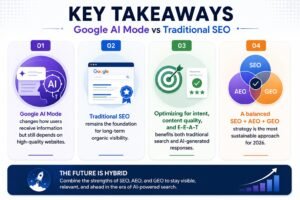
Key Takeaways
- Google AI Mode changes how users receive information but still depends on high-quality websites.
- Traditional SEO remains the foundation for long-term organic visibility.
- Optimizing for intent, content quality, and E-E-A-T benefits both traditional search and AI-generated responses.
- A balanced SEO + AEO + GEO strategy is the most sustainable approach for 2026.
How to Optimize Your Website for Google AI Mode in 2026
- Create Helpful Content That Solves Real Problems. Write for real questions your audience is asking, not generic keyword pages.
- Build Topical Authority Instead of Publishing Random Blogs. Interlink related articles so Google understands the full depth of your expertise on a subject. See how we structure this in Topical Authority Strategy.
- Optimize for Conversational Search Queries. Add FAQ sections, question-based H2 headings, and answer the core question in your first paragraph.
- Strengthen Your Technical SEO: Fast pages, mobile-first design, clean URLs, sitemap, schema, and strong internal linking.
- Implement Structured Data (Schema Markup). Article, FAQ, Organization, and Service schema all improve how search engines and AI systems interpret your content. See the schema recommendations at the end of this guide.
- Demonstrate Real Expertise: Author profiles, case studies, and original data strengthen E-E-A-T. Our own case studies are a good example of what this looks like in practice.
- Keep Your Content Fresh: Review statistics, examples, and internal links every 3–6 months.
- Improve User Experience: Clear navigation, short paragraphs, fast pages, mobile responsiveness.
- Build High-Quality Backlinks: Guest posts, digital PR, original research, and resource pages.
- Optimize for Both Humans and AI. Every page should be readable, well-structured, technically sound, and genuinely useful. This is the same principle behind our Content Marketing services, built specifically around content that ranks and converts.
Common Mistakes Businesses Should Avoid
- Publishing AI-generated content without human review
- Focusing only on keywords instead of intent
- Ignoring technical SEO issues
- Creating thin or duplicate content
- Neglecting internal linking
- Using outdated statistics or examples
- Failing to update existing articles
- Overlooking mobile usability and page speed
- Not implementing structured data
- Treating AI optimization as a replacement for SEO, not an addition to it
Action Plan for Businesses
- Audit your existing website for technical SEO issues
- Create content that directly answers customer questions
- Build topic clusters around your core services
- Add FAQ and structured data to important pages
- Improve Core Web Vitals and mobile performance
- Update older content with fresh insights
- Strengthen internal linking
- Showcase expertise through case studies and author profiles
- Earn high-quality backlinks
- Monitor emerging AI search trends and adapt
Conclusion
The debate around Google AI Mode vs Traditional SEO often implies businesses must choose one. In reality, they work together Traditional SEO builds the technical and content foundation, while AI-powered search changes how that content is discovered and consumed.
If you want a strategy that covers both traditional rankings and AI-search visibility, talk to our team for a free audit, or explore our full SEO services.
FAQs
- Is Google AI Mode replacing traditional SEO?
No. Google AI Mode complements traditional SEO. AI systems still rely on well-optimized, trustworthy websites to generate their responses. - How can businesses optimize for Google AI Mode?
Focus on high-quality content, technical SEO, structured data, topical authority, E-E-A-T, and content that answers user questions directly and clearly. - What is the biggest difference between Google AI Mode and traditional search? Traditional search displays ranked web pages. Google AI Mode generates a conversational summary using information pulled from multiple trusted sources.
- Does Schema Markup help with AI Search?
Yes. Schema helps search engines parse your content structure more precisely, improving eligibility for enhanced search features and AI citation. - Why is E-E-A-T important for AI-powered search?
Google prioritizes content that demonstrates real experience, expertise, authority, and trustworthiness so users receive reliable answers. - Can AI-generated content rank on Google?
Yes, if it’s accurate, original, reviewed by a human, and genuinely useful. Content produced purely to manipulate rankings tends to underperform. - Should businesses still invest in technical SEO?
Yes. Technical SEO keeps your site crawlable, indexable, fast, and accessible, the baseline requirement for both traditional and AI-powered visibility. - What is topical authority?
Topical authority is built by publishing comprehensive, interconnected content around one subject, demonstrating depth of expertise to search engines. Read more in Topical Authority Strategy. - How often should SEO content be updated?
Review and refresh important pages every 3 – 6 months to keep facts, examples, and links current. - What is the best SEO strategy for 2026?
Combine traditional SEO fundamentals with AI-friendly content structure, schema, and user-focused optimization. If you’d rather have this managed end-to-end, get a free audit from our team.